

Anger elicits anger, fear elicits fear, no matter how well meaning we may be.
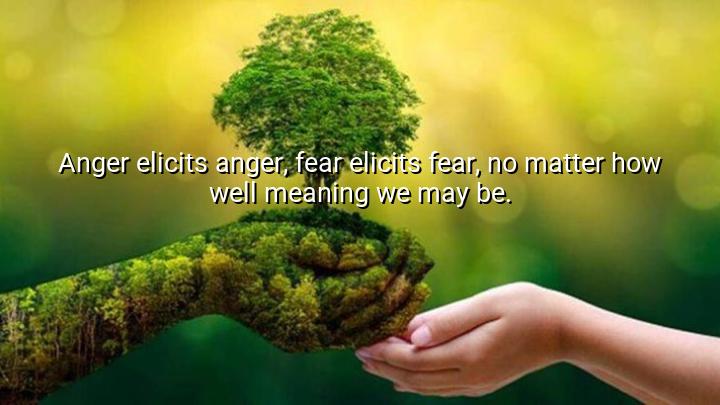




In this quote, Martha Beck reflects on the cyclical nature of human emotions and how one negative emotion often fuels another. She suggests that anger triggers more anger, and fear triggers more fear, regardless of one’s intentions. Even if we try to respond with good intentions, these emotions have an innate power to escalate the situation. Beck’s statement emphasizes that emotional reactions can quickly spiral out of control, creating an environment where the initial negative emotion intensifies, rather than dissipates.
Beck's insight points to the idea that emotions are contagious, and when one person reacts with strong emotions like anger or fear, those around them are likely to mirror or amplify those feelings. This can be especially problematic in situations of conflict or high stress, where an emotionally charged reaction can worsen the scenario. Beck’s point is that emotional responses are not always within our control, and what begins as a small issue can escalate quickly if the cycle of anger or fear is not broken.
The origin of this quote comes from Beck’s work as a life coach and author, where she explores themes of personal growth, emotional intelligence, and the psychology behind human behavior. Throughout her writing, Beck delves into how individuals can better understand and manage their emotions, especially in challenging situations. This quote serves as a reminder that we must be mindful of our emotional responses and how they can influence those around us.
Ultimately, Beck’s quote encourages us to be more aware of the impact of our emotions on others. Instead of responding with more anger or fear, she advocates for a more thoughtful, measured approach to conflict resolution. By breaking the cycle of negative emotions, we can create a more peaceful and productive environment for ourselves and others.

BLBac Long
I think this quote is so relevant in today’s climate. Emotions spread like wildfire, and even well-meant criticism can provoke resistance if wrapped in fear or frustration. But here’s my question: how do you remain authentic and emotionally honest without triggering others? Is it about using different language, shifting body language, or simply doing inner work so your message aligns with calm, confident energy?
TTTran thanh thao
This quote really resonates with me, especially as someone who often leads with passion but unintentionally escalates conflict. It’s a sobering reminder that delivery matters just as much as intent. But I’m also curious—what happens when anger or fear is justified? Should we always be trying to tone ourselves down for the sake of others’ comfort, or is there a way to be honest and still non-threatening?
YNHa Thi Yen nhi
What Martha Beck says here makes me think of social media arguments, where anger seems to multiply exponentially. Even when people have good intentions, the tone often becomes hostile fast. Is this emotional mirroring just part of human nature, or can we rewire ourselves to pause and respond differently? I’d love to know what kind of practices or disciplines help reduce these reactive spirals.
TVVu Tuong Vi
I find this quote insightful and a little concerning. If fear and anger are so contagious, how can we ever break the cycle? What does it take to stay grounded and not absorb or reflect someone else’s intensity? It feels like emotional self-regulation is more crucial than ever in this polarized world, but I wonder how we actually cultivate that kind of inner calm in the moment.
Kkhoa
This quote hits at something I’ve experienced countless times. Even when you’re trying to make a point for the right reasons, if you come across angry, people rarely hear your message—they just react defensively. It makes me wonder: how do we express strong emotions without triggering more of the same? Is it really possible to be assertive without being seen as aggressive in emotionally charged conversations?