

Anger begets more anger, and forgiveness and love lead to more forgiveness and love.
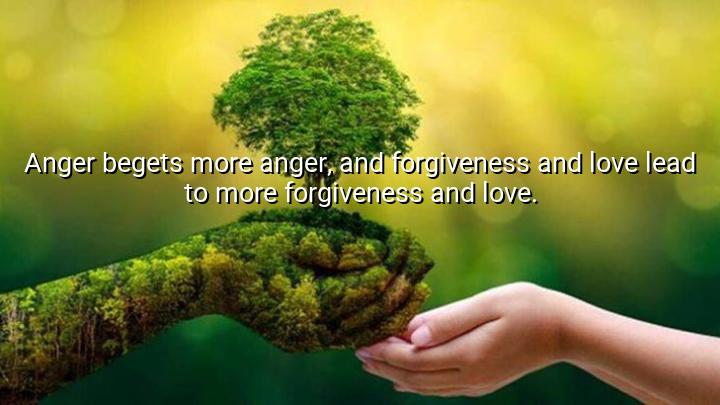




In this quote, Mahavira, an ancient Indian spiritual leader, highlights the cyclical nature of anger and forgiveness. He suggests that when we respond to anger with more anger, it only perpetuates the negative emotions, leading to a cycle of resentment and conflict. Conversely, when we respond with forgiveness and love, we create a positive cycle where these virtues inspire more forgiveness and love in others. Mahavira emphasizes that the way we react to others' emotions directly influences the emotional dynamics in our relationships.
The quote underscores the idea that emotions, whether positive or negative, tend to magnify based on how they are met. Anger, when left unchecked, escalates and spreads, often leading to greater hostility and violence. On the other hand, responding with forgiveness and love fosters understanding and compassion, paving the way for healing and peace. Mahavira teaches that the power to break the cycle of anger or hatred lies in the choice to embrace peace and compassion instead.
Mahavira's teachings are rooted in Jainism, a religion that emphasizes non-violence, self-control, and compassion for all living beings. His philosophy encourages followers to seek harmony by embracing forgiveness, love, and self-restraint. The core belief of his teachings is that by living a life free from hatred and resentment, one can achieve inner peace and promote peace in the world around them.
Ultimately, Mahavira’s quote serves as a reminder of the power of our responses in shaping the emotional climate of our relationships and our communities. By choosing forgiveness and love, we can disrupt the cycle of anger and create more positive, peaceful interactions, leading to a more harmonious life for ourselves and others.

THTran Trung Hieu
This quote highlights the power of our emotional responses in shaping outcomes. Can forgiveness and love be taught or cultivated to replace cycles of anger? What role do education, mindfulness, or spiritual practices play in this transformation? I’d be interested in discussing how societies can encourage these virtues to promote peace and understanding.
ANLinh Tuan Anh Nguyen
Reading this, I’m reminded that emotions are contagious, and our responses can shape social dynamics profoundly. Does this imply that choosing love and forgiveness is an active responsibility? How might this perspective affect conflict resolution on larger scales, like between groups or nations? It invites reflection on the broader impact of personal emotional choices.
HLHai Long
This quote makes me think about the role of empathy in perpetuating either anger or love. Could understanding the root causes of anger help us respond with forgiveness instead? How do cultural or personal differences influence whether people perpetuate cycles of anger or choose compassion? I’m curious about strategies to nurture forgiveness in difficult circumstances.
TDTran Le Thuy Duyen
I find this statement hopeful because it suggests that positive emotions can spread just like negative ones. But is forgiveness always easy or realistic in situations of deep hurt? How do people balance self-respect with the desire to forgive? It raises important questions about the limits and power of forgiveness in human interactions.
BNLe Bich Ngoc
This quote beautifully captures the cyclical nature of emotions and actions. How can individuals break the cycle of anger to foster forgiveness and love instead? Are there practical steps or mindsets that help shift from a reactive to a proactive approach in relationships and communities? I’d love to explore examples where forgiveness truly transformed conflict and promoted healing.