

An artist is a dreamer consenting to dream of the actual world.
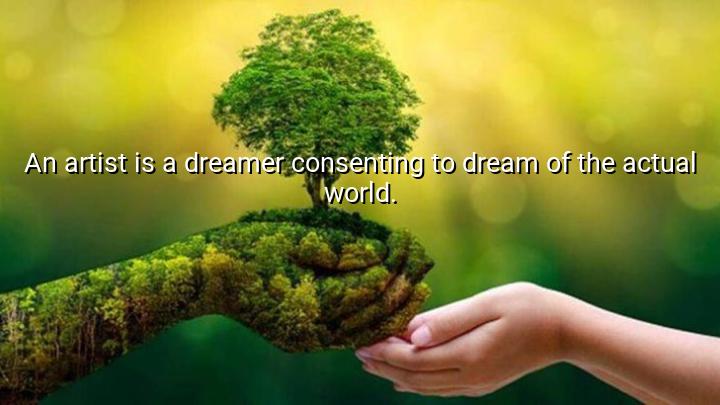




The quote "An artist is a dreamer consenting to dream of the actual world" by George Santayana reflects the unique role of the artist in shaping and interpreting reality. Santayana, a philosopher and poet, suggests that while artists are often seen as dreamers or visionaries, their dreams are not entirely detached from the world around them. Instead, the artist’s dreams are an exploration of the actual world, filtered through their personal experiences, emotions, and perceptions. By "consenting," the artist embraces the responsibility of transforming the mundane into something imaginative and insightful.
In this context, the artist is not merely escaping into fantasy but engaging deeply with the real world and its complexities. Through their work, they reimagine and interpret reality in ways that reveal deeper truths or offer fresh perspectives. The quote implies that the artist has a unique capacity to see beyond the surface of everyday life, envisioning new possibilities while staying connected to the world as it is. The dreamer aspect of the artist highlights the creativity and imagination involved in this process.
Santayana’s words also suggest that the act of creating art requires a kind of agreement between the artist and their environment. The artist must acknowledge and consent to dream about the actual world, allowing their artistic expression to bridge the gap between fantasy and reality. This perspective positions art as a dynamic reflection of both the inner world of the artist and the external, physical world they navigate.
Ultimately, the quote speaks to the symbiotic relationship between imagination and reality in the creative process. An artist is a dreamer, but their dreams are not disconnected from the world they experience. They use their artistic vision to reflect and reframe the world around them, offering new ways to see and understand reality.

UGUser Google
It’s interesting how Santayana defines the artist as someone who dreams while still staying grounded in reality. But can artists ever fully detach from the world they live in, even in their most abstract works? Can a truly original artistic vision exist without some connection to the artist’s real-life experiences or observations, or is every dream inevitably shaped by what the artist sees and feels in the world around them?
TDNguyen huynh thanh diep
Santayana's idea that an artist dreams of the actual world raises an interesting question: Can art ever be purely imaginative if it’s tied to the real world in some way? Or is it the artist’s ability to dream and then connect that dream to real experiences that gives their work its depth? How much of art is about exploring what is, and how much is about escaping or transcending it?
MNDuong Thi My Nhi
I love the idea of the artist as a ‘dreamer consenting to dream of the actual world.’ It makes me think about how artists reflect and reframe what is in front of them, offering us new perspectives. But does this mean that artists are always constrained by the world they see, or do they have the freedom to create worlds that challenge or question reality? Is art always rooted in the real, or can it exist purely as a dream?
HNhanh nguyen
This quote seems to suggest that art is a balance between fantasy and reality. The artist dreams but then chooses to channel that dream into something grounded in the world as it is. Does this mean that true art can only exist when it connects to real life in some way? Can an artist's dream ever be entirely separate from the reality they live in, or is that what makes the dream truly artistic?
TMTra My
Santayana's view of the artist as a dreamer is intriguing. It’s as if an artist not only imagines things beyond the physical world but also agrees to engage with the reality they see, interpreting it through their lens. How does this perspective shape the way we understand the role of art in society? Is the artist’s job to create an entirely new world, or should they focus on re-imagining the world we already live in?