

To be interested in the changing seasons is a happier state of mind than to be hopelessly in love with spring.
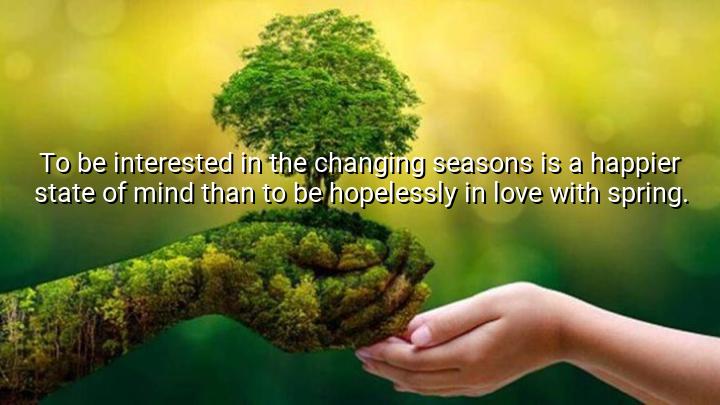




The quote by George Santayana, "To be interested in the changing seasons is a happier state of mind than to be hopelessly in love with spring," emphasizes the value of adaptability, mindfulness, and balance in life. Santayana contrasts the idea of being fixated on one ideal or moment—represented by spring—with the happiness that comes from appreciating life’s continual changes. By being aware of and interested in all the seasons, both literal and metaphorical, one cultivates a broader and more sustainable sense of contentment.
The origin of this quote lies in Santayana’s philosophical writings, where he frequently explored themes of nature, time, and human perception. A Spanish-American philosopher and writer, Santayana often reflected on how people experience beauty and joy in relation to the passage of time. Here, he uses the seasons as a metaphor for life’s cycles, suggesting that true happiness comes from embracing change rather than clinging to a single moment or ideal.
At its core, the quote speaks to the importance of flexibility and appreciation in life. While being in love with spring symbolizes a narrow focus on pleasure, interest in changing seasons represents an openness to growth, learning, and the natural ebb and flow of existence. It encourages a mindset that values diversity, impermanence, and the richness of life’s cycles.
Ultimately, this quote serves as a reminder to cultivate a balanced perspective. By appreciating life in all its phases and transitions, one can experience deeper and more lasting happiness, rather than fleeting joy tied to a single, idealized moment. Santayana celebrates the wisdom of embracing change as a path to inner fulfillment.

AAdministratorAdministrator
Welcome, honored guests. Please leave a comment, we will respond soon