

An artist carries on throughout his life a mysterious, uninterrupted conversation with his public.
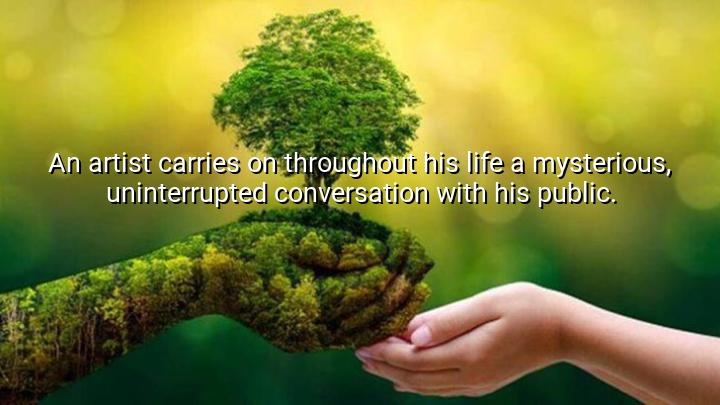




The quote "An artist carries on throughout his life a mysterious, uninterrupted conversation with his public" by Maurice Chevalier suggests that the relationship between an artist and their audience is ongoing, dynamic, and deeply intertwined. Chevalier implies that the artist is constantly engaging with their public, whether through direct interaction or the work they create. This "conversation" is not a literal exchange of words but a continuous process where the artist communicates ideas, emotions, and visions that resonate with the audience, while also being shaped by their responses and interpretations.
In this context, the word conversation reflects the way art serves as a dialogue between the artist and the public. This exchange is not always verbal or direct but occurs through the emotional, intellectual, and sensory impact that the art has on its audience. The artist may not always be aware of how their work is received, but the work itself speaks to the audience, creating a lasting connection that evolves over time.
The origin of this quote reflects Chevalier's own experiences in the world of entertainment and performance. As a French actor and singer, Chevalier was deeply connected to his audience, aware of the emotional bond that forms between an artist and those who experience their work. He saw his performances as a form of communication, where the energy and emotions of the audience influenced his artistry. His perspective aligns with the belief that art is never created in a vacuum but is always in dialogue with its viewers, listeners, or readers.
By stating that "An artist carries on throughout his life a mysterious, uninterrupted conversation with his public," Chevalier highlights the profound and lasting connection between the artist and their audience. This connection is ongoing, evolving, and often beyond the artist's conscious control, yet it is central to the creative process and the impact of the art. The quote reflects the idea that art is both a personal expression and a shared experience, continually influencing and being influenced by those who encounter it.

BCBui Cuong
There's something really mystical in how Chevalier describes the relationship between artist and public. It feels like a dance—subtle, ongoing, unspoken. But it also makes me question: who counts as the 'public'? Are we talking about critics, fans, casual viewers, or even future generations? That word feels broad and a bit impersonal. Can this kind of personal connection really exist across such a wide and diverse audience?
TDThuy Tien Dao
This quote hits me emotionally because it implies a lifelong connection between the creator and the audience. But what happens when that connection breaks? Some artists get ignored in their own time and only gain recognition posthumously. Does the conversation still exist then, just delayed? Or is it more accurate to say it was unheard for a while? It makes me think about how time and context affect artistic communication.
NTNhan Trong
I’m fascinated by the idea that art is a form of communication that never really ends. Even long after an artist has passed away, their work continues speaking to people. But it also raises the question—how much control does an artist have over that conversation? Once their work is out in the world, the public shapes its meaning too. Is it still the artist’s message at that point, or does it become something shared?
THToan Hoang
This quote makes me reflect on the vulnerability of being an artist. Imagine constantly engaging in a silent dialogue with strangers, never fully knowing how you're being understood. It must be both rewarding and exhausting. I wonder if some artists feel burdened by the public’s expectations, like their work must always 'say' something profound. Can an artist ever step away from that conversation, or is it truly uninterrupted, like Chevalier suggests?
LTAn Le thu
I love the idea that an artist has this ongoing, invisible dialogue with their audience. But I’m curious—how does that change with time? An artist’s work might mean one thing when it's first released, but decades later, the public might read it completely differently. Does the 'conversation' evolve, even after the artist is gone? Or is it more of a frozen moment, waiting to be reinterpreted by each new viewer?