

An artist cannot speak about his art any more than a plant can discuss horticulture.
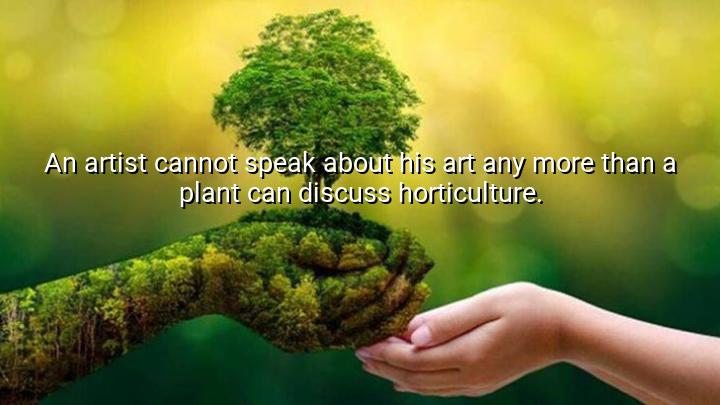




The quote "An artist cannot speak about his art any more than a plant can discuss horticulture" by Jean Cocteau suggests that true art is beyond the scope of verbal explanation. Cocteau compares the artist to a plant, implying that just as a plant cannot understand or articulate the process of its growth, an artist cannot fully explain the creative process or the depth of their work. Art, in this sense, exists on a level that transcends language, and the artist’s role is to create rather than to explain.
Cocteau’s perspective emphasizes the idea that art is an intuitive and natural expression, much like the way a plant grows without the need for self-awareness or reflection. The artist, similarly, creates from an internal drive, often without fully understanding the reasons behind their choices. To discuss the work in words might limit or distort its meaning, as words cannot fully capture the essence of creativity or the emotions behind it.
This quote reflects Cocteau's own views on the mystical and deeply personal nature of art. He believed that the artist’s role is to communicate through symbolism, form, and expression rather than through direct verbal communication. The artist's work, therefore, speaks for itself, and any attempt to explain it may reduce its mystery or power.
Ultimately, Cocteau’s quote suggests that art is a form of communication that goes beyond words. It’s a language of its own, one that allows the artist to express what cannot always be articulated. Just as a plant grows according to nature, the artist creates according to an inner, often unspoken, force, making it impossible to fully explain their art without diminishing its value.

THTai Ho
This quote almost feels like a defense against over-explaining. Maybe Cocteau was pushing back against critics or academia. But is it fair to suggest that artists lack the language or insight to discuss their work? Plenty of creators have powerful things to say about their process. Then again, perhaps the deepest parts of creation are wordless. I’m curious—do you think talking about art enhances or diminishes its impact?
TBTrong Bui
I wonder how this quote applies to art education. If artists can’t articulate their own work, how are they supposed to teach others? Or is Cocteau implying that art should be shown, not told? It’s an interesting challenge for teachers—balancing technique with intuition. I’d love to hear from art instructors on how they handle this in the classroom. Is the act of making art separate from the ability to talk about it?
NBngoc bui
Reading this, I feel a tension between instinct and intellect in art-making. Could it be that artists feel their work more than they understand it? If so, what role do critics and scholars play? Are they better suited to analyze and explain than the creators themselves? This quote makes me think that the mystery of art is best preserved when we don't dissect it too much—but then, don't we lose something in not trying?
THLE THI HUYEN
I totally get the metaphor, but part of me resists it. Isn't art partly about communication? If the artist can't speak about their work, how do we gain insight into intention or context? Or maybe Cocteau is saying that true expression comes from a place beyond rational explanation. It's a compelling idea, but I still think there's value in hearing artists try—even if imperfectly—to articulate what they create.
NANhu A
I find this quote oddly humbling. It makes me think that great art might not require explanation from its maker. Still, don’t you think artists should be able to reflect on their process, even if it's not academic? Or is the point that too much talking about art can dilute its essence? I’m torn—I love artist statements, but maybe there’s wisdom in just letting the work speak for itself.