

The day of my birth, my death began its walk. It is walking toward me, without hurrying.
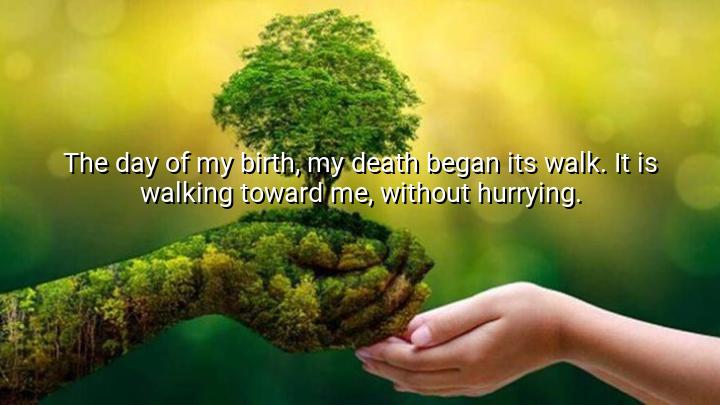




Jean Cocteau's quote, "The day of my birth, my death began its walk. It is walking toward me, without hurrying," reflects a deep understanding of the inevitable nature of mortality. Cocteau suggests that from the moment we are born, our death is set in motion, a constant companion that is always approaching, though never rushing. This insight speaks to the fragility and transience of human life, reminding us that death is not an external force but an integral part of our existence from the very beginning.
The phrase "walking toward me" conveys a sense of slowness and certainty. Death is not something that comes suddenly or unexpectedly, but rather something that moves gradually and predictably as time passes. Cocteau captures the inevitability of death, emphasizing that it’s always there, silently advancing, though we often remain unaware of its steady progression. The unhurried nature of this journey signifies that time itself is the most significant factor in the approach of death.
Cocteau, a French artist, filmmaker, and poet, often explored themes of life and death in his works. His quote encapsulates a recurring motif in his art: the fragility of life and the haunting inevitability of death. It speaks to the paradox that while we live our lives, we are simultaneously on a path toward the end of them, with each passing moment bringing us closer to the inevitable.
This meditation on death and existence challenges us to confront our mortality and consider the ways in which we live in relation to the knowledge that death is always present. Cocteau's philosophical view serves as a reminder to appreciate the time we have, as we walk alongside the gradual approach of our own end, which moves "without hurrying."

AAdministratorAdministrator
Welcome, honored guests. Please leave a comment, we will respond soon