

Although you may spend your life killing, You will not exhaust all your foes. But if you quell your own anger, your real enemy will be slain.
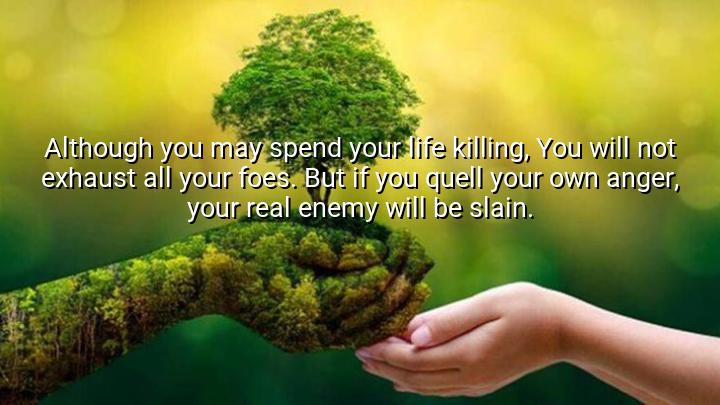




In this quote, Nagarjuna explores the concept of anger and its role in human conflict. He suggests that no matter how much you may fight or kill your enemies, you will never run out of foes. The more you engage in external battles, the more conflict you create. However, the real battle lies within: if you are able to quell your own anger, you will defeat your real enemy, which is not a person or an external force, but the anger itself. This highlights the idea that internal peace and self-control are the true paths to overcoming adversity.
Nagarjuna’s statement emphasizes that anger is a destructive force that, when left unchecked, perpetuates cycles of conflict. Rather than seeking to eliminate external enemies, he proposes that true victory comes from addressing the internal sources of anger and hatred. By controlling these emotions, one frees themselves from the endless cycle of revenge and hostility, leading to inner peace and wisdom.
The origin of this quote lies in the teachings of Nagarjuna, a prominent figure in Buddhist philosophy. His work focuses on understanding the nature of suffering and the path to enlightenment. Nagarjuna teaches that to overcome suffering, one must look inward and confront their own negative emotions. This quote reflects the Buddhist principle that peace is not achieved by fighting external battles, but by mastering one’s inner state, especially the destructive emotion of anger.
Ultimately, Nagarjuna’s quote serves as a powerful reminder that the true path to peace lies within oneself. By quelling anger, one overcomes the real enemy—self-destructive emotions that cloud judgment, foster resentment, and perpetuate cycles of conflict. This perspective encourages individuals to seek inner harmony as the most effective way to confront life's challenges and achieve a deeper sense of fulfillment and freedom.

Ttranthaonguyen
This statement resonates with many spiritual traditions emphasizing inner peace. However, is it realistic to expect complete eradication of anger, or is moderation a more attainable goal? How does this concept impact how we view justice and retaliation in society? It’s a thought-provoking call to shift focus from external violence to internal harmony.
HTNguyen Sy Huy Tuan
Reading this, I’m curious about the practical steps one can take to ‘quell’ anger effectively. Are mindfulness and meditation enough, or does it require deeper psychological work? Also, how does culture influence our understanding of anger as an internal enemy? This seems like a profound reminder that the hardest battles are often within.
TPThao Tran Phuong
This quote makes me think about the nature of anger and its power over us. Is anger always an enemy, or can it sometimes serve a protective or motivational role? How can one discern when to quell anger and when to channel it productively? This invites a nuanced exploration of emotional intelligence and self-awareness.
TMnguyen tuyet mai
The metaphor of killing foes but never exhausting them contrasts sharply with the idea of slaying the ‘real enemy’ inside. Does this imply that external conflicts are distractions from our deeper emotional challenges? How might this quote apply to modern conflicts, whether interpersonal or societal? It seems to advocate for introspection as the path to true peace.
TTLe Thi Thu Thuy
I find this perspective both humbling and empowering. It suggests that the real battle is within ourselves rather than with external enemies. How do different philosophies or cultures approach the idea of conquering internal anger? Could this mindset reduce violence and promote compassion if more widely adopted? I’d like to explore the techniques that help people achieve such self-mastery.