

Allowing children to show their guilt, show their grief, show their anger, takes the sting out of the situation.
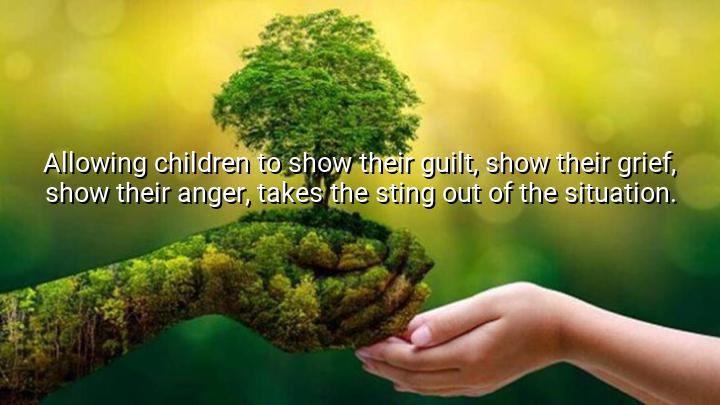




In this quote, Martha Beck emphasizes the importance of allowing children to express their guilt, grief, and anger openly. Beck suggests that by providing children with the freedom to show these emotions, it can help to alleviate the emotional intensity of the situation. Rather than repressing or shaming them for their feelings, giving them the space to process and release these emotions helps to reduce their negative impact and promotes emotional healing.
Beck’s statement highlights the idea that emotional expression is essential for emotional regulation. When children are encouraged to express their emotions instead of suppressing them, they are able to confront difficult feelings in a healthy way. This approach fosters emotional resilience and creates a safe environment where children learn that it’s okay to feel and express difficult emotions without fear of judgment or punishment.
The origin of this quote can be traced to Beck’s work as a life coach and writer, where she often discusses the importance of emotional honesty and self-acceptance. As a proponent of mindfulness and emotional well-being, Beck has focused on how we can help others, particularly children, navigate complex emotions. Her perspective on parenting and emotional development encourages openness and acceptance in both adults and children.
Ultimately, Beck’s quote teaches that by allowing children to express their emotions—whether it's anger, grief, or guilt—we create an opportunity for them to process and move through their feelings in a constructive way. This not only reduces the emotional weight of difficult situations but also supports the development of emotional intelligence and a healthy approach to conflict resolution.

DMPham Duc Manh
I’m intrigued by the suggestion that expressing emotions takes the sting out of situations. Does this imply that emotional repression makes problems worse? It makes me question how many adults today carry unresolved guilt or anger from childhood because they weren’t allowed to express those feelings. How might schools and families work together to foster healthier emotional expression from a young age?
PTPhuongg Thaooo
This perspective feels very compassionate, highlighting the importance of emotional safety. I wonder if allowing children to show guilt or anger also helps adults better understand the root causes of behavior. Could this reduce punitive responses and promote empathy instead? It seems like creating space for these emotions might lead to stronger trust and communication between children and caregivers.
BTPham Ngoc Bao Tram
Reading this, I’m curious about cultural differences in how children’s emotions are handled. In some societies, expressing emotions openly might be discouraged—does that make situations sting more? Could this idea also apply to adults, where suppressing emotions increases suffering? I’d love to explore how emotional expression across different age groups and cultures affects healing and relationships.
A101 - Phuong Anh 12A5
I appreciate the idea that letting children express difficult emotions can reduce the intensity of tough situations. But it also raises a practical question: How do caregivers balance allowing emotional expression with setting boundaries? For example, how can parents encourage children to express anger without letting it turn into destructive behavior? This quote encourages me to think about the fine line between validation and discipline.
HTTruc Huynh Thanh
This quote really resonates with me, especially as a parent. It makes me wonder how often adults suppress children’s emotional expressions thinking it’s for their own good. Could allowing kids to openly show guilt, grief, or anger actually help them develop healthier emotional coping skills? I’d be interested in hearing from child psychologists about how validating these feelings early on influences long-term mental health and resilience.