

All the art of living lies in a fine mingling of letting go and holding on.
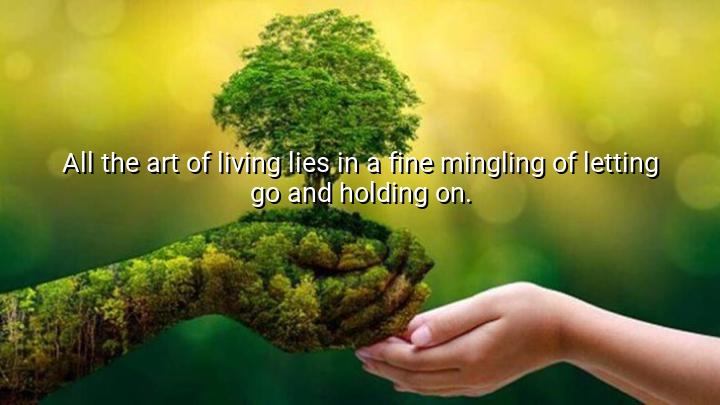




In this quote, Havelock Ellis suggests that the art of living is found in the delicate balance between letting go and holding on. He implies that life requires us to know when to release things—whether they be emotions, situations, or relationships—and when to hold on to what is important. The ability to navigate these two opposing forces, knowing when to embrace and when to release, is what makes living meaningful and fulfilled. It speaks to the balance of attachment and detachment that one must master to live harmoniously.
The origin of the quote is grounded in Ellis' exploration of psychology and human behavior. As a psychologist and writer, Ellis was interested in how people interact with the world, especially in terms of their emotional and mental health. His understanding of human relationships and personal growth led him to recognize that personal growth often involves knowing when to let go of past hurts or attachments, while still holding on to key principles, values, and connections that give life meaning and direction.
Ellis’ view emphasizes that living is not about rigidly holding onto everything, nor is it about total detachment. Instead, the art of living lies in the ability to make conscious choices about what to retain and what to release, based on the circumstances. This perspective encourages flexibility, self-awareness, and emotional wisdom in navigating the complexities of life. It’s about finding peace in knowing when to engage and when to step back.
Ultimately, this quote suggests that balance is essential for a fulfilling life. The wisdom of letting go allows for personal growth, healing, and the freedom to move forward, while holding on to what truly matters ensures that we remain connected to our core values, relationships, and goals. The quote serves as a reminder that the ability to manage both aspects is key to living a rich and harmonious life.

TTTrang Thu
Does this quote suggest that the 'art' of living is something we have to actively practice, like a skill we refine over time? Because I often feel like I’m either clinging too tightly or letting things slip away too quickly. Is balance something people are born better at, or can it be learned through experience and reflection? I'd love to hear how others approach this kind of emotional equilibrium.
LPDieu Linh Phung
Honestly, this hits me hard right now because I’m going through a period of transition. I’m trying to figure out what parts of my old life I need to carry with me, and what to leave behind. How do you make peace with choices that feel right in one moment and wrong in the next? Is the struggle part of the 'art' the quote refers to, or a sign I’m doing it wrong?
PLPhuong Linh
I appreciate this sentiment, but it makes me wonder—how do cultural backgrounds influence our sense of what to hold on to and what to release? Some cultures deeply value tradition and commitment, while others prioritize individuality and moving forward. Do you think this quote can be interpreted differently depending on those cultural lenses? Or is the message universal, despite our different values and experiences?
ATAnna Tran
Reading this, I feel torn. There’s something poetic and true about the balance it describes, but practically speaking, how do we know if we’re holding on out of love or fear? Similarly, letting go sometimes feels like quitting. How do you differentiate between healthy detachment and emotional avoidance? It seems like a very fine line, and one we cross without even noticing until it’s too late.
TLho trieu Long
I feel like this quote captures the essence of emotional maturity. But I'm curious—how do we teach this to younger generations who are constantly told to either 'move on' or 'never give up'? Isn’t the nuance here kind of lost in today’s all-or-nothing mindset? It seems like life often pushes us toward extremes, so how do we consciously practice this middle path in real time?