

A man that does not know how to be angry does not know how to be good.
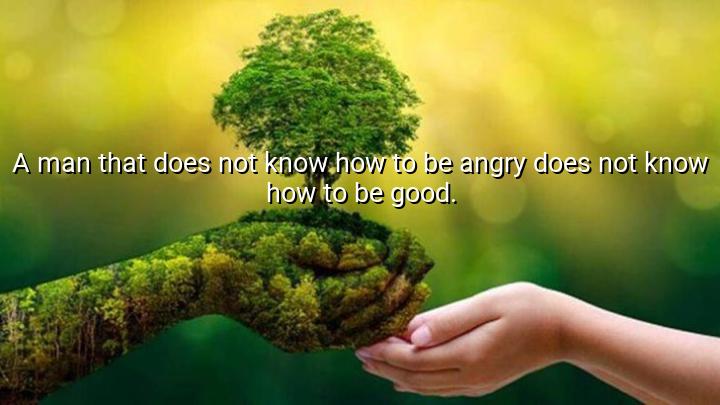




In this quote, Henry Ward Beecher argues that anger, when properly understood and managed, is an essential part of being good. He suggests that a person who cannot experience or express anger in response to injustice or wrongdoing may lack the necessary moral sense to stand up for what is right. Beecher implies that anger is not inherently bad but can be a force for good when it motivates individuals to take action or defend what is just.
Beecher's words reflect a more nuanced view of anger, emphasizing that it is a natural and important emotion, not something to be suppressed entirely. According to this perspective, anger arises when people witness something that contradicts their values or sense of justice. Without the ability to feel anger in these situations, a person might fail to act in defense of others or moral principles. In this sense, anger can be a catalyst for positive change and social good.
The quote also suggests that empathy and moral clarity are linked to one’s ability to experience anger. Someone who is deeply in tune with the pain or wrongs suffered by others is more likely to respond with righteous anger, which can push them toward acting in ways that promote fairness, compassion, and ethical behavior. A person who is indifferent to injustice may lack the emotional drive needed to take meaningful action.
Ultimately, Beecher’s quote underscores the idea that emotional depth—including the ability to experience anger—is tied to moral integrity. By recognizing anger as a tool for good, it challenges individuals to engage with their emotions in a way that drives them toward justice, kindness, and moral action rather than passivity or apathy.

VLHoang Van Linh
This quote makes me think about emotional education and self-awareness. If knowing how to be angry is linked to being good, should anger management programs include lessons on righteous or purposeful anger? How can people learn to express anger in ways that align with their values? It raises the idea that emotions are not inherently good or bad but need to be understood and guided thoughtfully.
NADang Ngoc Anh
Reading this, I wonder about the balance between anger and goodness in leadership or activism. Does the ability to express anger constructively help drive social justice and reform? Or could it risk alienating others if not managed well? It seems that knowing how to channel anger appropriately might be essential for effective and compassionate action, which is a nuanced skill.
HNthai ha ngo
This statement makes me reflect on the role of emotions in ethics. Can someone be truly good if they don’t feel anger at wrongdoing? Or is it possible to be good through calm understanding alone? I’m curious about how different philosophies or religions interpret the connection between anger and virtue. Could this perspective encourage people to embrace their anger as a catalyst for positive change rather than deny it?
THHa Thi Thu Hoan
I find this quote intriguing because it implies that anger can be a sign of moral awareness rather than a negative trait. Does this mean that people who never get angry might lack a certain depth of empathy or justice? How do we differentiate between healthy anger that motivates good actions and harmful anger that causes damage? It seems to suggest that emotional awareness is key to being genuinely good.
BLTran Bao Long
This quote challenges the common idea that goodness means always being calm and forgiving. Does it suggest that anger is a necessary emotion to recognize injustice or stand up for what’s right? I wonder how anger can coexist with kindness without becoming destructive. Could it be that knowing how to be angry in the right way is actually part of moral integrity? It raises the question of whether suppressing anger might hinder true goodness.