

A man paints with his brains and not with his hands.
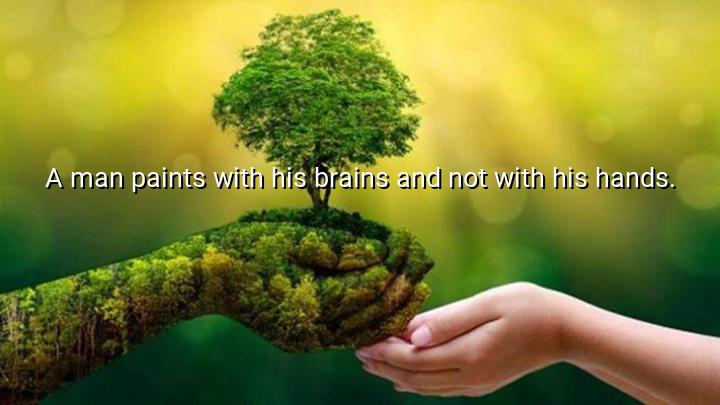




The quote "A man paints with his brains and not with his hands" by Michelangelo emphasizes the idea that true artistic creation comes from intellectual and conceptual thought, rather than just physical execution. Michelangelo is suggesting that the power of a painting or any form of art lies in the artist's vision, creativity, and understanding of the subject matter. While technique and physical skill are important, it is the brain—the artist's ideas, interpretations, and vision—that drives the creation process.
In this context, Michelangelo is challenging the notion that art is merely about manual skill or technical precision. Instead, he emphasizes that the artist's mind and intellect are the real sources of inspiration and guidance. The hands may carry out the work, but it is the brain that decides what to create, how to approach the subject, and how to express the inner vision. This view elevates the artist as a thinker and innovator, not just a craftsperson.
The origin of this quote is tied to Michelangelo's own perspective on art and creativity. As a Renaissance master, he was known not just for his exceptional technical ability, but also for his deep intellectual approach to his work. Whether in his sculptures, paintings, or architectural designs, Michelangelo believed that art should be guided by thought and reason, with the mind directing the hands to produce something greater than mere replication or technique.
By stating that "A man paints with his brains and not with his hands," Michelangelo emphasizes the importance of intellectual engagement in the creative process. This perspective reflects his belief that art is a manifestation of the mind's deepest thoughts and emotions, which are then brought to life through physical execution. The quote challenges us to see art not just as a craft but as a form of intellectual and emotional expression that transcends technique alone.

GHGiang Ha
Michelangelo's quote makes me reflect on the relationship between craft and concept. It’s easy to admire a painting for its beauty or complexity, but this suggests that the real power lies in the thinking behind it. I wonder how this view fits with abstract or spontaneous art, where the process seems more instinctual than intellectual. Is there always a 'brain' behind the brush, even in the most chaotic expressions?
TVNguyen Thi Tuong Vy
This feels like a timeless reminder that true artistry lies in vision, not just execution. But I wonder—how does this translate in collaborative art forms where many hands are involved, like film or animation? Is the 'brains' part shared among the team, or does it still rely on one driving mind? It’s a profound statement, but I’m curious about its limits in different artistic mediums.
QNQuynh Nhi
I really appreciate this quote because it shifts focus away from the physical act of creating and toward the intellectual effort behind it. It makes me think of how people often assume artists are just 'naturally talented' with their hands, when in fact, so much of what they do involves deep reflection, planning, and decision-making. Maybe this is a reminder not to underestimate the mental labor involved in visual art.
NTNgoc Tran
Is this a critique of artists who focus too much on technical mastery without a strong concept? It kind of flips the typical praise for 'skillful hands' on its head. I’m wondering—could this also apply to other creative fields like design or architecture? It seems like a call for more intentional, thoughtful creation rather than just executing beautiful images. I'd love to hear how this resonates with contemporary artists.
BBbin ben
Michelangelo’s words feel like a challenge to how we evaluate art today. With so much emphasis on aesthetics or realism, do we sometimes forget to appreciate the thought behind the work? It’s refreshing to be reminded that the value of a painting might lie more in the ideas it expresses than the brushstrokes themselves. Should we spend more time asking what an artwork means instead of how technically perfect it is?