

A guilty conscience needs to confess. A work of art is a confession.
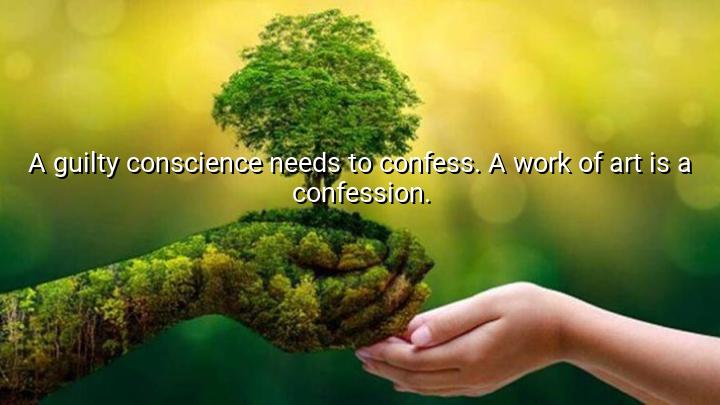




The quote "A guilty conscience needs to confess. A work of art is a confession" by Albert Camus explores the relationship between personal guilt and the creation of art. Camus, a French existentialist philosopher and writer, suggests that creating art serves as a form of self-expression or catharsis, particularly for the artist dealing with inner turmoil or unresolved emotions. Just as a guilty person feels the need to confess their wrongdoings to ease their conscience, an artist may feel compelled to express their internal struggles through their work, which becomes a form of personal confession.
In this context, Camus implies that art is not just a technical or aesthetic endeavor, but an emotional release for the artist. The creation of art allows the artist to confront and communicate their deepest thoughts, feelings, and guilt. This confession through art can be both a means of self-understanding and a way to communicate complex, often painful emotions to the outside world, enabling the artist to find relief or redemption.
Camus also suggests that art serves as a mirror of the artist's inner world. Much like a confession reveals personal truths, a work of art exposes the artist's thoughts, fears, desires, and conflicts. Whether consciously or unconsciously, the act of creating art forces the artist to confront their own conscience and express what might be difficult or impossible to put into words, allowing them to process their emotions and experiences.
Ultimately, Camus’s quote highlights the therapeutic and revealing nature of art. Through the process of creation, artists can confront their guilt, their struggles, and their inner conflicts, offering a form of emotional release that is both personal and universal. By turning their inner turmoil into a work of art, they make their personal confession, not just to themselves, but to society at large.

DTDuong Dao Thuy
I can't help but feel that Camus' view on art as a confession might suggest that all art, at its core, is deeply personal and linked to the creator's internal world. But does this confession always need to be something negative, like guilt? Can art also reflect joy, hope, or love in a way that still holds the power of confession? What kind of emotional truths might artists express when they are not wrestling with guilt?
TNTony Nguyen
This quote raises an interesting question about the role of personal experiences in art. Is the idea that ‘art is a confession’ a necessary characteristic of all art, or can an artist create a work purely from technical or intellectual motivation, without any emotional or moral reflection? And what does it mean for the viewer—do we experience art as a confession from the artist, or do we interpret it through our own lens?
THtran tho hung
Camus' statement makes me reflect on whether art is always a reflection of inner conflict or guilt. What happens when artists create works that are meant to be purely aesthetic, or purely for external purposes like commercial success or entertainment? Is there always a hidden layer of confession beneath, or can art be detached from personal turmoil? Could there be a difference between ‘good’ art and ‘bad’ art based on the depth of this personal truth?
KNLe kim ngan
I find this idea of art as a confession to be both beautiful and slightly unsettling. Art certainly reveals something of the artist’s state of mind or perspective, but do we, as viewers, always see that confession clearly? Does the artist’s intent really matter, or do we interpret art through our own biases and experiences? How much of the ‘confession’ is constructed by the viewer rather than the creator?
HMLe Hai Minhh
This quote feels quite profound. It suggests that art serves as a way for the artist to unburden themselves, almost as if the act of creation is a therapeutic release. But is every work of art truly a confession, or does Camus exaggerate the personal nature of it? Can art also be a form of escapism or a distraction from guilt, rather than a means of confronting it directly?