

I was born poor and without religion, under a happy sky, feeling harmony, not hostility, in nature. I began not by feeling torn, but in plenitude.
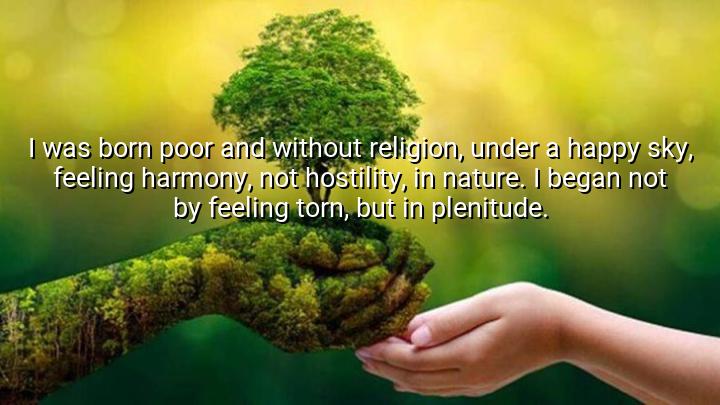




In this quote, Albert Camus, the French philosopher and writer, reflects on his early life and the sense of peace and harmony he felt in his natural surroundings. He notes that he was born poor and without religion, yet he experienced a deep connection with the harmony of the world around him, rather than any sense of hostility. This is significant because it highlights a worldview where nature and existence, for Camus, are not defined by struggle or conflict but by a kind of wholeness or completeness. His early experiences seem to set the stage for his later philosophical ideas, particularly his emphasis on existentialism and the search for meaning in a seemingly indifferent universe.
Camus contrasts this feeling of plenitude with the idea of being torn—a central theme in his existential works. In many of his writings, Camus explores the tension between the search for meaning and the apparent absurdity of life. However, in this quote, he begins by describing a more harmonious existence, one where the absence of organized religion or societal constraints allowed him to feel a sense of wholeness and peace with the world. It suggests that his early life gave him a foundation of balance and a deep connection to life itself, without the pressures or conflicts that often come from religious or social systems.
The absence of religion in Camus’s upbringing is noteworthy because, throughout his career, he frequently critiqued religious institutions and the idea of a higher divine power governing human existence. This quote implies that he felt no need for religious doctrine to shape his understanding of life; instead, his relationship with the world was grounded in a direct, unmediated experience of nature and the present moment.
Ultimately, Camus’s reflection on his early life emphasizes the idea of starting with a sense of balance and unity rather than conflict or confusion. He describes a beginning rooted in natural harmony and an absence of the inner turmoil that often comes with religious or societal expectations. This sense of plenitude that he experienced as a child would later influence his philosophical explorations of human existence, meaning, and the pursuit of truth in a world that often seems indifferent or even hostile.

AAdministratorAdministrator
Welcome, honored guests. Please leave a comment, we will respond soon