

You use a glass mirror to see your face; you use works of art to see your soul.
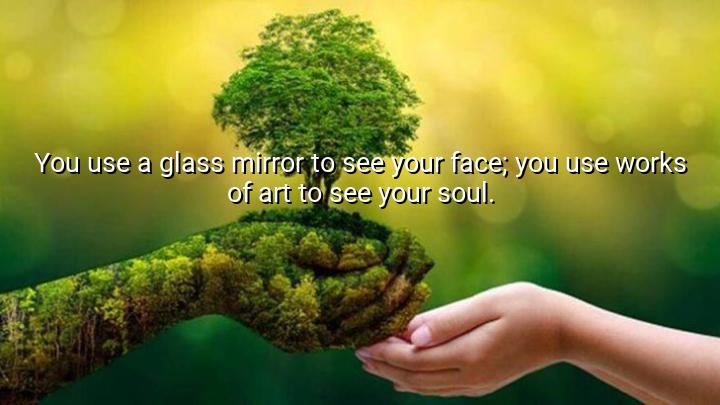




In this quote, George Bernard Shaw draws a distinction between the mirror and art as tools for self-reflection. A glass mirror allows us to see our external appearance, showing us how we look on the outside. However, Shaw suggests that to understand our deeper self, our soul, we need something more profound—art. According to Shaw, works of art serve as a mirror for the inner workings of the human spirit, offering insight into our emotions, thoughts, and values.
Shaw’s statement implies that while a physical mirror can show us our physical self, it is art that has the power to reveal our true nature and essence. By engaging with art, whether it be through painting, music, literature, or other forms, we are prompted to reflect on who we are, what we believe in, and what we feel. Art allows us to explore the depths of our identity, uncovering parts of ourselves that may be hidden or difficult to articulate.
The quote also suggests that art has the ability to connect us with our innermost selves in a way that ordinary, everyday tools cannot. It is through the imagination and creative expression in art that we come to understand not just our appearance, but our emotional and psychological states. Art serves as a lens for self-discovery and emotional catharsis.
Ultimately, Shaw’s quote emphasizes the transformative power of art. It suggests that while physical mirrors offer a limited reflection of the surface, art provides a deeper, more meaningful way to understand our soul. Through art, we are able to confront and embrace the complex, layered aspects of our humanity.

TMtran my
Reading this, I started thinking about the types of art that have stayed with me over the years. They weren’t always the most beautiful or technically impressive, but the ones that made me feel something or question something about myself. Shaw's quote nails that experience. But it also makes me curious—can people avoid seeing their soul through art? Is ignoring or dismissing certain works a kind of self-denial?
THTuan Ho
This quote really puts the viewer at the center of the artistic experience. It makes me think about how art is not just about the artist’s intent, but the viewer’s interpretation. But isn’t that a bit self-centered? Shouldn’t we also be using art to understand others, not just ourselves? I'm torn between appreciating the introspection and wondering if it overlooks art's power to create empathy and social awareness.
NTMan Nhi Tu
I love the metaphor Shaw uses—it’s poetic and deeply psychological. It suggests that engaging with art is a kind of self-confrontation. But I wonder, does this mean we only value art that reflects something back to us personally? What about abstract works or experimental art that challenge more than reflect? Can those still help us see our ‘soul,’ or is that a more specific kind of emotional recognition he's referring to?
CNChau Nguyen
What Shaw says really resonates with me. There’s something deeply revealing about how certain pieces of music or paintings stir emotions we didn't even know we were holding. But I also wonder—what does it mean for people who feel numb or disconnected from art? Does that say something about their soul, or is it more about conditioning and exposure? Not everyone feels that connection, and I find that gap interesting.
ATle anh thu
This quote makes me wonder—do we really use art to see our soul, or is it more accurate to say we project ourselves onto art? I’m curious if Shaw is talking about intentional reflection or something more subconscious. For example, two people can look at the same painting and come away with entirely different feelings. Is that because the art reflects who they are, or because they bring their own baggage to it?