

Without art, the crudeness of reality would make the world unbearable.
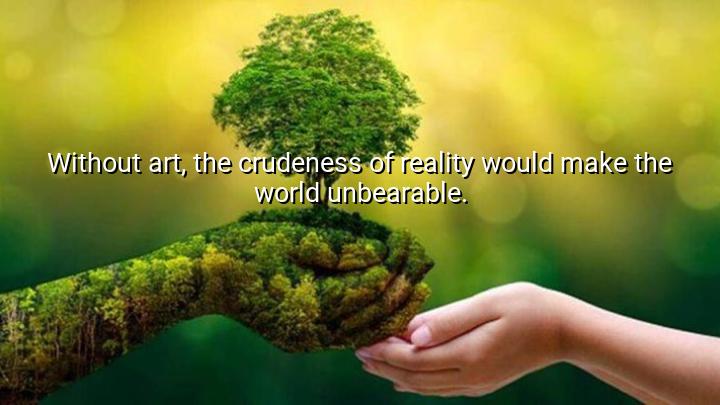




The quote "Without art, the crudeness of reality would make the world unbearable" by George Bernard Shaw speaks to the essential role that art plays in making sense of and elevating the often harsh and raw aspects of reality. Shaw suggests that art is a buffer between the chaos or brutality of everyday life and our ability to endure it. Without the beauty, meaning, or emotional depth that art provides, the world could feel overwhelmingly harsh and devoid of the comfort or inspiration that art brings.
In this context, art serves as a tool for transformation, turning the ordinary or difficult aspects of reality into something meaningful, engaging, or even beautiful. Whether through visual art, literature, music, or performance, art helps us cope with life’s challenges by offering an escape or a new perspective. It allows individuals to process their emotions, reflect on societal issues, and find hope in otherwise difficult circumstances.
The origin of this quote reflects Shaw’s broader philosophy about the role of art in society. As a playwright and critic, Shaw often used his works to comment on social, political, and human issues, demonstrating how art can challenge and reshape our understanding of the world. His view on art aligns with the idea that it is not just a form of entertainment, but a vital means of giving meaning to existence and providing emotional and intellectual relief from the harshness of life.
By stating that "Without art, the crudeness of reality would make the world unbearable," Shaw underscores the idea that art humanizes and refines the raw, often harsh elements of the world. It allows us to process difficult truths and find beauty or significance in the midst of life's challenges. Art provides a way to endure and even transcend the crudeness of reality, making the world a more bearable and meaningful place.

AKAnh Kieu
What I find interesting here is the implication that reality, on its own, is unbearable. That’s a heavy thought. Does this mean art exists solely to distract us, or can it also transform that reality into something we can live with—or even love? I’m torn between seeing art as a coping mechanism and as a revolutionary force. Could both be true depending on the artist’s intent?
CVDao Chinh Vuong
This quote made me pause and reflect. It suggests that art isn’t a luxury—it’s a necessity. That’s powerful. But I’m left wondering: how do we ensure access to art for everyone, especially in struggling communities? If it truly shields us from the worst parts of life, shouldn’t it be treated like a public good, like clean water or education? It’s a provocative idea worth serious policy debate.
KTKieu Thuy
Shaw’s statement strikes me as both poetic and brutally honest. There’s a kind of therapeutic truth here—art doesn’t just embellish life, it humanizes it. But does that make artists the real stewards of emotional survival? Are they the unsung healers of society? I’d love to see this explored in a documentary or a public conversation. It makes me reevaluate how we value creative work in general.
HNTRAN THANH HIEN NGUYEN
This quote sparks such a strong emotional reaction. I’ve often turned to movies or music during hard times, and it does feel like art makes life more bearable. But is it possible that too much art—especially entertainment—can also become a way to avoid facing real issues? Where’s the line between comfort and distraction? I’d love to hear someone argue both sides of that question.
HMGia Su Huyen Mai
I agree with Shaw in principle, but I also wonder: what counts as art in this context? Is it just the traditional forms—paintings, literature—or can everyday things like street fashion, memes, or graffiti also count as a buffer against reality’s bluntness? Maybe the definition of art is expanding, and with it, our resilience to life’s cruelty. I’m curious how others interpret this quote in the digital age.