

Wherever art appears, life disappears.
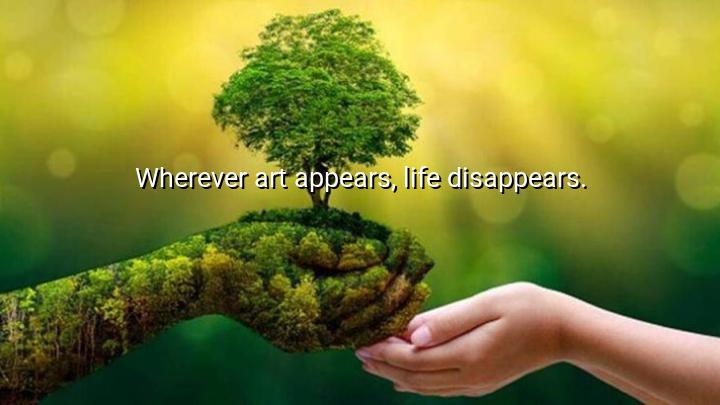




The quote "Wherever art appears, life disappears" by Robert Motherwell suggests that art has the power to transcend the ordinary aspects of daily life, creating a space where the realities of the world are momentarily suspended. In this context, Motherwell implies that when we engage with art, we enter a realm that exists beyond the mundane concerns of daily existence. Art creates an environment where the focus shifts away from the practical and the real, allowing for exploration of deeper emotions, concepts, and expressions.
Motherwell, an influential American painter and one of the leading figures of the Abstract Expressionist movement, often sought to convey complex emotional and psychological states through his work. This quote reflects his belief that art is a space for personal and creative freedom, where the constraints of everyday life—such as routine, practicality, or social expectations—are momentarily forgotten. In a sense, art becomes a vehicle for escaping the limitations of reality, offering a form of release or transcendence.
The origin of this quote is tied to Motherwell’s artistic philosophy, where he viewed art as a means of expressing the inner workings of the human psyche, rather than merely representing external life. By stating that life disappears in the presence of art, he suggests that the artist’s creative vision and emotional depth take precedence over the practicalities of life, allowing for a more profound connection with the audience. Art, in this view, exists as a distinct realm of expression and thought.
For artists and art lovers, this quote can serve as a reminder of the unique power of art to take us out of the ordinary flow of life and into a space where emotions, ideas, and experiences can be explored and expressed freely. It encourages both the creator and the viewer to embrace the ability of art to open up new dimensions, where the constraints of everyday life are left behind in favor of imaginative exploration.

MNNguyen Minh Nguyen
I find this quote pretty unsettling. Is it meant as a critique of art’s power to distract us from the real world? Or maybe it's about how the moment we frame something as 'art', we remove it from its living context and turn it into an object for analysis. That feels true for some types of modern art, where the concept can overshadow the emotion. Still, I’m not convinced life truly disappears—it transforms.
TDNguyen Thai Duong
This feels like a provocative statement, maybe even intentionally so. It challenges the romantic idea that art is life or that it breathes life into the world. But maybe Motherwell is highlighting how art abstracts or edits life—it takes something messy and full of motion and freezes it in time. I’d love to know if he saw this as a limitation of art, or just part of its nature.
HHHang Hoang
I wonder if this quote is more about the artist than the audience. Maybe Motherwell felt that the act of creating art pulled him away from living in a conventional sense—relationships, routines, obligations. Is art inherently isolating or even obsessive? If that’s true, what does it say about the emotional cost of making great work? It opens up a deeper question about balance between creativity and being present in the world.
PCHoang Phuong Chi
This quote strikes me as almost paradoxical. Art is made by humans, from lived experience, so how can it make life disappear? Maybe Motherwell means that when we step into an artwork—mentally or emotionally—we leave reality behind and enter a constructed world. That makes sense in a way, but does it mean art competes with life rather than contributes to it? I'm torn between seeing this as profound or too pessimistic.
KNTran Kim Ngoan
I’m not sure I fully agree with this statement. Can’t art actually bring life into sharper focus? When I see a powerful painting or hear a moving piece of music, it feels like life is enhanced, not erased. Maybe Motherwell was talking about abstraction, or how art creates a kind of artificial reality. But even then, isn’t that still rooted in human experience? It makes me curious about his broader philosophy.