

Where the spirit does not work with the hand, there is no art.
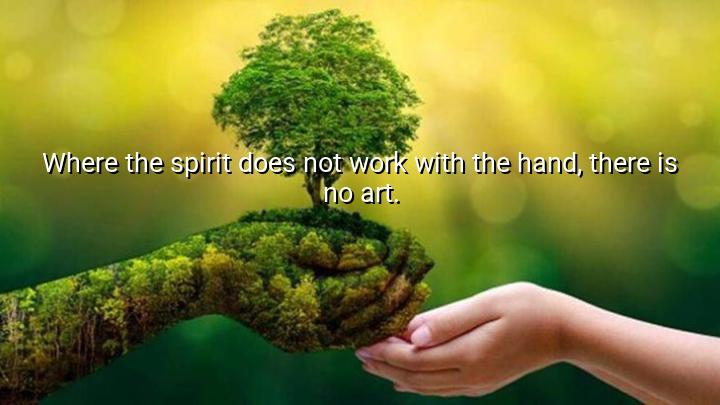




The quote "Where the spirit does not work with the hand, there is no art" by Leonardo da Vinci emphasizes the essential connection between the intellectual and emotional aspects of the creative process. Da Vinci suggests that true art is not just about technical skill or craftsmanship, represented by the hand, but also about the spirit—the artist's passion, vision, and soul—guiding the creation. Without this harmonious relationship, the work lacks depth, meaning, and authenticity, making it more mechanical than artistic.
In this context, spirit refers to the artist’s inner drive, creativity, and emotional investment in the work, while the hand represents the physical execution of the creative process. The quote conveys that art is not simply about reproducing what is seen or following prescribed techniques. Instead, it requires the fusion of intellectual and emotional energy with skillful action, ensuring that the work is not only technically proficient but also imbued with personal meaning and insight.
The origin of this quote can be traced to da Vinci's own approach to art, which integrated both scientific precision and deep emotional engagement. As a polymath, he sought to understand the world in all its complexity, and his art reflected this balance of intellectual exploration and emotional expression. Da Vinci’s works, such as the Mona Lisa and The Last Supper, show how mastery of technique is only part of what makes them masterpieces—it's also the depth of thought and feeling that infuses them.
By stating that "Where the spirit does not work with the hand, there is no art," da Vinci underscores the idea that art is a dynamic and holistic process. It requires not just the application of skill but the emotional and intellectual input of the artist. This perspective highlights that art is deeply personal and rooted in the artist’s inner world, making it a true reflection of human experience.

HNhuynh nhu
As someone who struggles with confidence in their creative work, this quote is both comforting and challenging. It reminds me that perfection in execution doesn’t matter as much as being sincere and present in the process. But it also makes me ask: how do I know if my spirit is truly engaged? Is it a feeling, a flow state, or just a deep intention behind what I do?
LLLinh Linhh
There’s something deeply spiritual about this quote. It’s like da Vinci is saying that the soul must guide the hand in order for anything we create to have real value. But what does that mean for people learning art? Is it possible to ‘train’ the spirit as much as the hand? Or is it something innate that only reveals itself with time and experience?
GBDao Nguyen gia bao
I wonder if this quote also applies beyond traditional art forms. Like, what about coding, architecture, or even cooking? When someone pours their heart and soul into their work, doesn’t it become a kind of art, too? Maybe da Vinci was ahead of his time in recognizing that true creation is a fusion of thought, emotion, and physical effort. Can we broaden this idea to all acts of creation?
HHhuy hoang
I love the way this quote elevates intention and emotion over raw technique. It suggests that art isn’t just about making something look good—it’s about imbuing it with purpose, feeling, and presence. But what if someone’s 'spirit' is chaotic or conflicted? Can their turmoil still translate into genuine art, or does the spirit need to be clear and resolved for the hand to truly create?
DDDo Duy
This quote really makes me think about the difference between craft and true artistry. Can someone technically skilled but emotionally disconnected still create something meaningful? It seems da Vinci is saying that technique alone isn’t enough—that art must come from a deeper, more soulful place. Do you think this still applies in an age where digital tools can automate so much of the creative process? Where does the 'spirit' fit in today?