

When God created you, He went to great lengths to make you exactly the way He wanted you to be. You are His ultimate work of art.
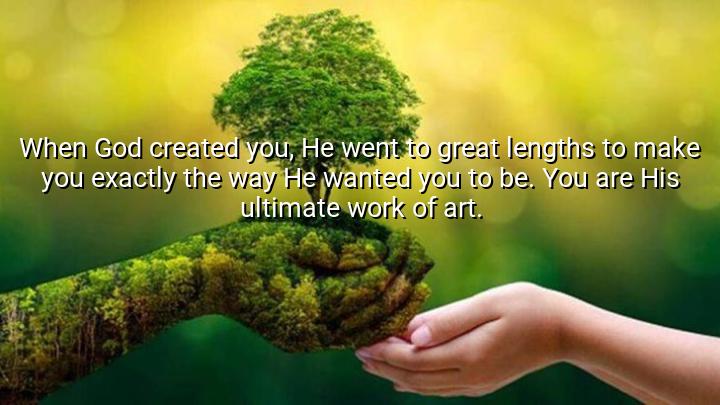




In this quote, Victoria Osteen emphasizes the idea that each individual is a unique creation designed by God with great care and intention. She suggests that, just as an artist carefully crafts their work of art, God meticulously designed each person to be exactly as they are meant to be. The quote reinforces the concept that every individual is part of God’s plan, and their qualities—whether physical, emotional, or spiritual—are deliberate and purposeful, reflecting God's divine craftsmanship.
Osteen’s statement also carries a message of self-worth and empowerment, reminding individuals that they are valuable and significant. By describing people as God’s ultimate work of art, she underscores the inherent beauty and purpose in each person’s existence. The implication is that, just as art is treasured and appreciated for its uniqueness and creativity, so too should individuals recognize their own worth and embrace their inherent qualities with pride.
The quote reflects a broader spiritual perspective, emphasizing that humans are not random occurrences but intentional and meaningful creations. It calls for a sense of gratitude and appreciation for one’s self, recognizing that every aspect of who they are—whether perceived as flaws or strengths—is part of a divine and beautiful design. Osteen is encouraging individuals to see themselves through a spiritual lens, understanding their value in the grand scheme of God's creation.
Ultimately, Osteen’s quote speaks to the profound idea that every person is an expression of divine creativity, and that they should embrace their individuality as part of a greater purpose. This perspective encourages a sense of self-love and appreciation, seeing oneself as an integral and cherished part of a larger, divine creation.

THVo Thi Thanh Hong
This quote reminded me of the idea that each person carries inherent dignity. But I’m curious—how does this concept translate into how we treat others? If everyone is God's ultimate artwork, shouldn't that radically shape our interactions, policies, and social values? Do we, as a society, live up to that belief, or is it mostly a personal sentiment rather than a collective practice?
MTDo Minh Thuan
As someone who struggles with self-worth, I appreciate this quote’s attempt to frame our existence as intentional and valuable. But part of me wonders—how do we internalize this belief in a world that constantly compares, criticizes, and commodifies identity? Is faith alone enough to resist those pressures, or do we also need cultural shifts to truly live out this sense of divine worth?
MNMinh Nguyen
I find this idea beautiful—almost poetic in how it equates our existence to art. But it raises a deeper question: If every individual is a masterpiece, how do we reconcile that with the reality of cruelty or harmful behavior in some people? Can we say everyone is a divine creation while also holding them accountable for the darkness they may bring into the world?
NNNghi Nguyen
This quote feels empowering, almost like a gentle affirmation wrapped in faith. Yet I can’t help but wonder—does seeing ourselves as 'God's ultimate work of art' place pressure on us to live up to some divine ideal? What happens when we fall short or make mistakes? Can embracing imperfection coexist with the belief that we were created intentionally and perfectly?
PKphuc khang
I love the comforting tone of this quote, especially for anyone battling self-doubt. It frames self-worth not as something earned but as something inherent. But does this belief require a strong faith in God to be truly meaningful? I'm curious how someone spiritual but not religious might interpret it. Can this perspective be inspiring for those who don't share the same theological framework?