

What is art but a way of seeing?
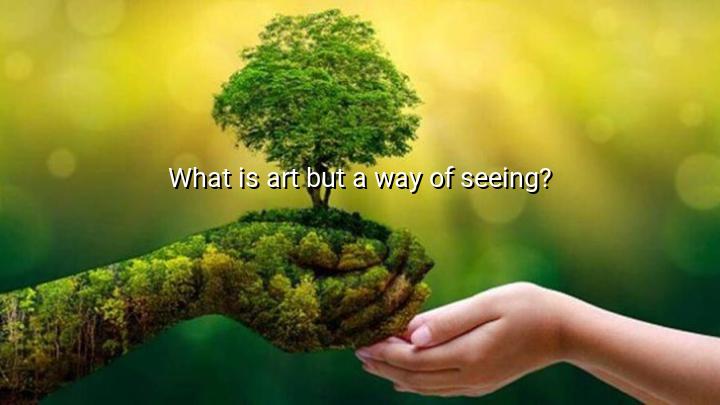




The quote "What is art but a way of seeing?" by Saul Bellow suggests that art is not just about creating objects or representations, but about offering a new perspective on the world. According to Bellow, art enables the artist and the viewer to see life differently, revealing aspects of reality that might otherwise go unnoticed. Through art, we can explore new ways of understanding, experiencing, and interpreting the world around us.
Bellow’s statement emphasizes the role of perception in art. It is through the act of seeing, both literally and metaphorically, that art comes to life. Whether through painting, literature, music, or other forms, art provides a lens through which we view and interpret our experiences, thoughts, and emotions. In this sense, art is about transforming ordinary perceptions into something profound, elevating the everyday into the realm of the meaningful.
The origin of this quote reflects Bellow's belief in the power of art to shape human consciousness. As a writer and thinker, he was interested in the relationship between individual perception and broader societal understanding. His works often explored how our unique ways of seeing the world influence our personal and collective experiences. This quote encapsulates his view that art is a powerful tool for shifting perspectives, opening minds, and deepening awareness.
By framing art as a "way of seeing," Bellow encourages us to understand that art is not simply about creating something visually pleasing or aesthetically valuable, but about engaging with the world in a new, transformative way. Art challenges us to look at life from different angles, encouraging a more nuanced and thoughtful approach to our existence and experiences.

VHnguyen van hung
This quote is both beautiful and a little frustrating. It suggests that art is more about perception than production, which resonates, but also raises a question—what happens to the value of art as a profession? If everyone 'sees' differently, does that make all expressions equal? Or is there still a hierarchy, where certain 'ways of seeing' are more impactful or meaningful than others? I'd love to know how artists feel about this.
TNTrinh-10Van Nguyen
I feel like this quote quietly critiques how society often separates 'art' from everyday life. If art is about seeing, then maybe it’s everywhere—in the way someone arranges objects in their home, tells a story, or even dresses. That opens the door to seeing life more creatively. But it also makes me wonder: do we lose something when we call everything 'art'? Does the term become too vague to mean anything at all?
SShine
If art is defined by how we see, then is it possible to make art that challenges us to see differently, even uncomfortably? I think of abstract or conceptual works that initially confuse or repel viewers. Are they more successful because they shift our perception? Or is that too academic of a view? Sometimes I just want to enjoy something visually without being forced to rethink everything I know.
VAChu Van An
This really changes how I think about art. It makes me ask: whose way of seeing are we being asked to engage with when we view art? Is it purely the artist's, or does the viewer reshape it through their own lens? I like the idea that art isn't just something we look at, but a shared way of seeing—a kind of dialogue. But can that ever be objective, or is it always personal?
TMPham Hoang Thao My
I love the simplicity and depth of this idea, but I’m also curious—does this mean that art is more about interpretation than creation? If it’s primarily about how we see the world, does that downplay the skill or craft behind artistic work? I think there’s beauty in that democratization of art, but I also wonder if it risks reducing the value of years of artistic training and discipline.