

What art offers is space - a certain breathing room for the spirit.
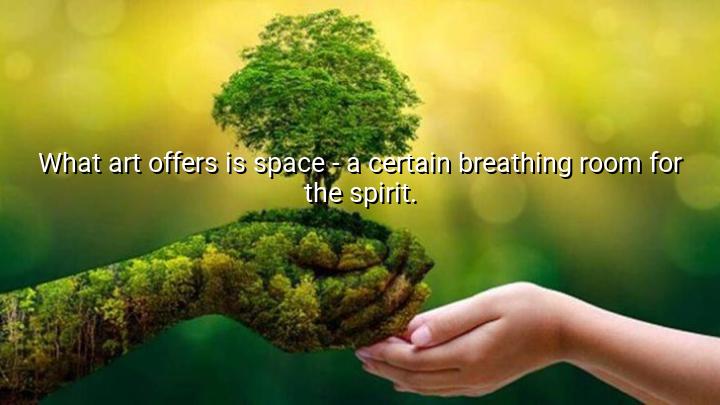




The quote "What art offers is space - a certain breathing room for the spirit" by John Updike suggests that art provides individuals with a mental and emotional refuge, offering the spirit a chance to pause, reflect, and expand. Updike implies that through engagement with art, people can find relief from the pressures and constraints of daily life, creating a space where their thoughts and emotions can flow freely. Art becomes a sanctuary, allowing the viewer or creator to breathe and explore ideas, feelings, and concepts that may not have room to exist in the hectic pace of the world.
Updike, known for his literary works that delve deeply into human experiences and emotions, recognizes the power of art to offer more than just visual or intellectual stimulation. For him, art has the ability to nourish the spirit by creating a space where the individual can experience a sense of freedom and introspection. Whether through literature, painting, or other forms, art provides an environment where one can escape the confines of daily life and enter a realm of creativity and possibility.
The origin of this quote comes from Updike's broader understanding of the role of art in human life. He often explored the ways in which art, culture, and personal reflection intersect to shape our understanding of the world and ourselves. In this quote, he focuses on the emotional and spiritual value of art, seeing it not as mere decoration or entertainment but as an essential tool for personal growth and inner peace.
For artists and art lovers, this quote highlights the transformative power of art as a means of providing both solace and freedom. Updike’s words remind us that art is not just about aesthetics or intellectual pursuits, but about creating a space where the spirit can feel liberated, inspired, and deeply connected to the human experience. It encourages individuals to embrace the space that art offers, using it as a way to nourish their emotional and spiritual well-being.

HNHien Nguyen
Reading this quote made me think about how art creates a different kind of time—almost like stepping outside the normal flow of life. Is that what Updike means by ‘space’? A pause in the daily grind? If so, then maybe art’s greatest value isn’t in what it shows us, but in how it lets us feel unstuck. Has anyone else ever felt like a painting or a poem helped them breathe again?
VNvy nguyen
I’m intrigued by the spiritual undertone here. Is Updike suggesting that art serves a similar function to meditation or prayer? If so, does that mean engaging with art requires a kind of reverence or ritual? I’ve definitely had moments with certain works—music, especially—that felt like a form of inner expansion. But I wonder, does everyone experience that, or is it something you have to be conditioned to appreciate?
VNTrinh Van Nguyen
This quote gives me comfort. In a culture that constantly demands productivity, the idea that art is meant to create space rather than fill it is powerful. But does this only apply to experiencing art, or also to creating it? I wonder if artists themselves feel this breathing room when they work—or if the process is sometimes just as chaotic and stifling as life itself.
UCNguyen Thi Uyen Chi
I love the poetic feel of this quote, but I’m curious—does it imply that art is primarily therapeutic or spiritual? What about political or provocative art that’s meant to unsettle? Can something that confronts or challenges us still count as 'breathing room'? Or is Updike talking more about the emotional range art can offer, even if it includes discomfort? That seems like a deeper kind of emotional space.
Aanh-meme-meo-hai-huoc-7
This quote makes me think of museums and galleries as almost sacred spaces. They aren't just places to look at things—they’re sanctuaries where you're allowed to slow down, reflect, and breathe differently. But does art always have to be 'calm' to provide this kind of space? Can even chaotic, disturbing art still give us that mental breathing room by breaking us out of routine thought patterns?