

What art is, in reality, is this missing link, not the links which exist. It's not what you see that is art; art is the gap.
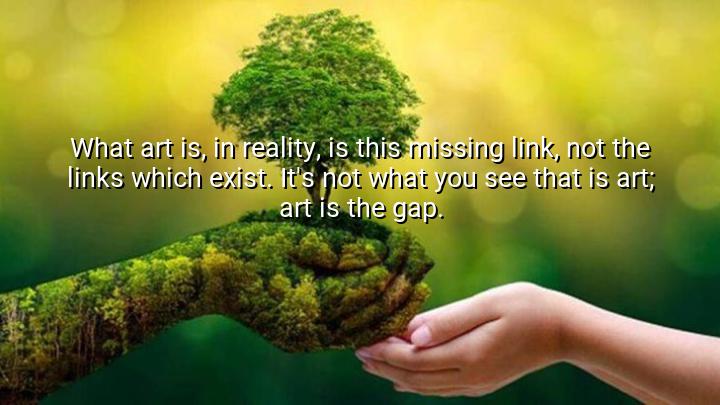




The quote "What art is, in reality, is this missing link, not the links which exist. It's not what you see that is art; art is the gap" by Marcel Duchamp offers a profound perspective on the nature of art. Duchamp, a French-American artist and a key figure in the Dada movement, challenges traditional definitions of art. He argues that art is not defined solely by the physical objects we can see, such as paintings or sculptures, but by the "gap" or the space between the artist's intention and the viewer's interpretation.
Duchamp’s view suggests that art is not merely what is visible or tangible, but what is left unsaid, unexplored, or implied. The "missing link" refers to the part of art that is not immediately presented—it's the abstract or conceptual space that the viewer must engage with to complete the experience. This gap exists between what the artist has created and what the audience perceives, interpreted through their own thoughts, emotions, and experiences.
The idea that art is the gap shifts focus from the object itself to the interaction between the work and the viewer. Duchamp's quote implies that the true essence of art lies in this interaction—the act of discovery and interpretation that fills the gap between the artist's creation and the viewer’s understanding. This concept aligns with Duchamp's revolutionary approach to art, where the boundaries of what constitutes art were stretched, such as in his famous piece Fountain, a ready-made urinal that challenged conventional ideas of aesthetic beauty.
Ultimately, Duchamp’s quote emphasizes the conceptual and interpretative nature of art. It suggests that the value of art does not reside purely in what is visible or easily understood but in the space for thought, questioning, and engagement that art invites. This gap is where the true experience of art happens, making it not just about seeing, but about understanding, feeling, and participating in the creation of meaning.

DTTran Duc Thuan
This quote made me question the way we exhibit and consume art. If the essence of art is in the gap, does that mean museums, galleries, and even social media miss the point by focusing on what’s physically displayed? Should curators and critics do more to highlight the unseen or implied aspects of a work? I wonder how curatorial practices might evolve if they embraced this philosophy fully.
APBui hoang anh phu
Duchamp’s words make me think about negative space in design or music—the idea that absence can be more powerful than presence. Does this mean the silence in music or the blank canvas in visual art holds more meaning than the notes or brushstrokes themselves? If so, how can artists intentionally create 'gaps' for interpretation without being overly abstract or inaccessible to their audience?
KTPhan Ky Tai
As someone who leans toward traditional art forms, I struggle with this quote. I appreciate technical skill and visual beauty, so the idea that art isn’t what I see feels a little dismissive. Is Duchamp suggesting that aesthetic appeal is irrelevant? If art is only about ideas or interpretation, does that devalue craftsmanship? I’d like to understand how modern and conceptual artists reconcile this with the work they physically create.
NNLe Thi Ngoc Nhi
I find Duchamp’s perspective fascinating because it opens up a whole philosophical dimension to art. Could it be that art is actually a question, not an answer? If the 'gap' he mentions refers to the distance between perception and reality, does that mean the value of art is found in what it provokes rather than what it presents? How does this view shape the role of artists in society?
TYthan thi yen
This quote feels kind of unsettling to me. If art isn’t what we see but the space around or between it, does that mean the physical artwork is just a placeholder? How do we know when something qualifies as art if it’s defined by what’s not there? I’m left wondering whether Duchamp was encouraging us to be more imaginative—or just playing with our heads entirely.