

We're all works of art in progress.
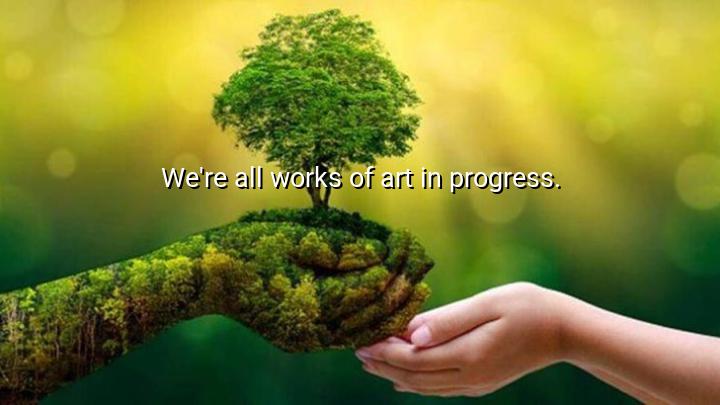




Carmen Dell'Orefice’s quote, "We're all works of art in progress," speaks to the idea that every individual is continuously evolving and developing, much like a work of art. Dell'Orefice, a model and artist, suggests that human life is a process of growth, change, and self-expression, where each person is a living, breathing creation, constantly refining and reshaping themselves. This perspective emphasizes the fluidity and dynamic nature of personal identity and experience.
By referring to people as "works of art," Dell'Orefice highlights the notion that individuals are complex, multi-dimensional creations, shaped by their experiences, choices, and interactions with the world. Just like an artist’s work, a person is always a work in progress, continually being molded and redefined. The quote suggests that we are all involved in an ongoing journey of self-discovery and expression, with no final or permanent form, but always changing and adapting.
Dell'Orefice's statement also touches on the imperfection inherent in the human experience. A work of art is never truly "finished" but constantly evolving, just as we, as individuals, are always in the process of becoming. The idea that we are works of art in progress encourages us to embrace growth and transformation, understanding that who we are today may not be who we are tomorrow. It’s a reminder that each step in our journey contributes to the creation of our unique, evolving self.
Ultimately, Dell'Orefice’s quote serves as a powerful metaphor for human life, encouraging us to see ourselves as dynamic and ever-changing, with endless potential for growth and reinvention. It suggests that we should approach life as an artist approaches their work—mindfully, with a sense of purpose, and open to the beauty of change and personal development.

BTnguyen bao tran
Such a beautifully simple yet profound idea. If we’re all works of art in progress, then maybe comparison is pointless. But we constantly compare ourselves to others. Does this quote help shift that mindset, or is it too idealistic to stick in real-world situations? I’m curious how this sentiment plays out in different cultures or age groups—does it resonate more with people who’ve had time to reflect, like Carmen herself?
UGUser Google
I see this quote as a celebration of human resilience and potential. It’s like saying, ‘You’re not done, and that’s the whole point.’ But I also wonder—how does this metaphor hold up for those who feel stuck or broken? Does the comparison to art risk idealizing pain too much? I’m torn between loving its positivity and questioning whether it fully acknowledges life’s real, messy complexities.
HN30.Nguyen Thi Hanh Nhung
There's something comforting and humanizing about this quote. It reframes imperfection as beauty in progress, rather than failure. I do wonder, though: in a world obsessed with results and perfection, how can we keep that mindset alive? Is it enough to remind ourselves, or do we need societal change to support this perspective? I'd love to hear how others incorporate this belief into their daily lives and self-talk.
KATran Ngoc Kim Anh
What I love about this quote is the idea that we’re not finished, and that’s okay. But it also makes me think—who gets to decide what kind of 'art' we become? Are we the artists of our own lives, or is society holding the paintbrush too often? I’d be curious to explore how external influences shape our sense of self-development and if that compromises our authentic 'artistic' identity.
M(Tran Anh Minh (Fschool_CG)
This quote resonates deeply with me. It’s a gentle reminder that growth and transformation are ongoing, not just something we go through in youth. It makes me wonder—why do we often treat flaws or setbacks as permanent when, like art, we can evolve? Does viewing ourselves as art help us extend more compassion to ourselves? I think it encourages self-reflection without judgment, which feels pretty powerful in today’s fast-paced world.