

We should always remember that sensitiveness and emotion constitute the real content of a work of art.
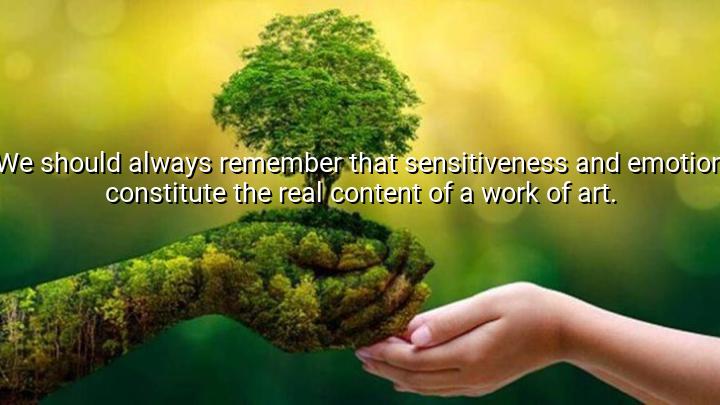




In this quote, Maurice Ravel, a renowned composer, emphasizes the importance of sensitiveness and emotion as the core elements that give a work of art its true value. He suggests that technical skill, while important, is secondary to the emotional depth and sensitivity that the artist brings to their creation. For Ravel, the emotional content of a piece is what makes it meaningful and impactful, as it resonates with the audience on a deeper level.
Ravel’s focus on sensitiveness suggests that an artist's ability to tap into their own emotional experiences and express them through their medium is what makes their work truly powerful. Art, in this view, is not just about execution or perfection but about conveying the emotional truth of the artist’s experience. This emotional depth can create a connection between the artist and the audience, allowing them to feel the same emotions and experience the art in a more personal way.
The quote also highlights that emotion is not just an accessory to the artwork but its real content—the foundation on which the work stands. Whether in music, visual art, or literature, it is the emotions and sensitivities conveyed that define the piece’s ability to evoke a response in others. In Ravel’s work, for example, his music is known for its emotional richness and sensitivity, qualities that transcend mere technical ability.
Ultimately, Ravel’s statement reminds us that art is not just about technique or aesthetics; it is about the emotions and sensitivities that the artist channels through their work. It is these qualities that allow art to move people, to transcend time, and to remain meaningful across generations. Through emotional expression, art can truly connect individuals with the deepest parts of the human experience.

HHHong Hoang
I wonder how Ravel’s idea applies across cultures. Different societies express emotion in unique ways—some subtly, others boldly. If emotion is the soul of art, does that mean art is universally accessible regardless of language or tradition? Or does our ability to feel what the artist felt depend on cultural context and shared experiences? I’d love to hear thoughts on whether emotion in art can truly transcend those boundaries.
PPPhong Pham
Ravel’s insight makes me question the role of AI-generated or algorithmic art. If the true content lies in human sensitivity and emotion, can non-human creations ever reach that depth? Some digital pieces can be visually stunning, but I often feel like something is missing emotionally. Do you think machines can ever replicate the emotional truth that comes from human experience, or is that something uniquely ours?
MTTrinh Minh Tu
This quote resonates with me because it echoes why art has always felt like a safe space—where emotions are not only allowed but essential. It makes me think about how often society devalues emotional expression, yet art demands it. Do you think this is why artists are often perceived as more emotionally in tune or even more vulnerable? Is creating art an act of emotional courage in today’s world?
PNDoan Phuong Nhi
I love how this quote elevates emotion as central to artistic value. But I’m curious—how do we judge sincerity in a work of art? Can emotion be faked or manufactured for impact, and if so, does that make it less valid? In a world where audiences often seek authenticity, it’s worth asking: is it the artist’s intent or the viewer’s response that truly determines whether a piece resonates emotionally?
GNluong gia nghi
Ravel’s take raises an interesting question about interpretation. If emotion and sensitivity are the heart of art, how does that affect the way we analyze or critique it? Is there a risk that academic or technical evaluations strip away the essence? I wonder if we need to rethink how we teach and review art to better honor its emotional impact rather than just its formal structure or innovation.