

Unlike a drop of water which loses its identity when it joins the ocean, man does not lose his being in the society in which he lives. Man's life is independent. He is born not for the development of the society alone, but for the development of his self.
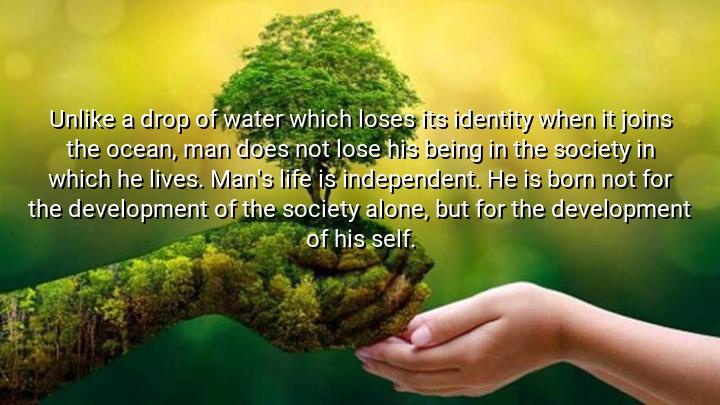




The quote "Unlike a drop of water which loses its identity when it joins the ocean, man does not lose his being in the society in which he lives. Man's life is independent. He is born not for the development of the society alone, but for the development of his self" by B. R. Ambedkar emphasizes the importance of individuality and self-development within a society. Ambedkar contrasts the loss of identity experienced by a drop of water when it merges with the ocean, with the idea that a person does not lose their individuality when they become part of a larger society. Instead, he argues that self-realization and personal growth are essential aspects of a person's life, independent of societal expectations or pressures.
B. R. Ambedkar, an Indian jurist, social reformer, and the principal architect of the Indian Constitution, was deeply concerned with individual rights, equality, and the empowerment of marginalized groups. This quote reflects his belief in the dignity and freedom of the individual, particularly in the context of caste and social oppression in India. Ambedkar’s work focused on the idea that society should not stifle the development of the individual; instead, both should coexist in a way that allows for personal growth and freedom.
The phrase "Man's life is independent" highlights the notion that while individuals are part of a broader social framework, their identity, purpose, and life's work should not be entirely defined by societal norms or expectations. Self-development, as Ambedkar emphasizes, is not simply about contributing to society but also about nurturing one's own values, ambitions, and capacities. This underscores the idea that personal freedom and individual growth are just as important as contributing to the collective good.
Ultimately, Ambedkar’s quote champions the idea of independence and self-empowerment within the context of society. It challenges the belief that people should exist solely for the advancement of society, asserting instead that individual development is a fundamental right. By recognizing the independence of the individual, Ambedkar highlights the importance of nurturing both the self and the community in harmony, ensuring that the pursuit of personal growth is not diminished by societal constraints.

TNTham Nguyen
Is Ambedkar subtly critiquing collectivist ideologies like communism here? I can't help but read this quote as a defense of liberal individualism, but maybe I'm projecting. Still, it feels like he’s asserting a kind of existential autonomy that refuses to be erased by social structures. That’s powerful—but how practical is it in tightly regulated or communal societies where personal choice is limited by tradition or law?
::///
Reading this, I feel a sense of empowerment—but also pressure. If we are born for the development of the self, how do we define what that even means? Is it career success, spiritual fulfillment, emotional growth, or all of the above? Ambedkar’s point seems liberating, but it also raises the anxiety of self-direction. What happens if someone never figures out what their ‘self-development’ path looks like?
DXDong Duong Xuan
Does this imply that societies that suppress individualism are inherently flawed or unjust? I feel a little torn here. On one hand, protecting individuality is essential for creativity and freedom. On the other, collective values like solidarity and shared purpose are equally important. Where do we draw the line between respecting the individual and enforcing social cohesion? Is there a cultural bias here that needs examining more deeply?
YLYen Le
I’m intrigued by the contrast Ambedkar draws between human identity and the natural metaphor of a drop of water merging into the ocean. It raises a philosophical dilemma: should individual identity always be preserved, or are there circumstances where merging into a collective benefits everyone? For example, in times of national crisis, is it morally superior to prioritize society over self-development? Or does that risk eroding what makes each person unique?
HTNgoc Hai Tran
Is Ambedkar challenging the idea that we should sacrifice individuality for the greater good? I find this thought-provoking, especially in cultures where conformity is often valued. Can a person fully thrive and contribute meaningfully to society if their individuality is constantly being subdued? It makes me question whether social development and personal development are always in conflict—or can they be harmonized more effectively?