

My social philosophy may be said to be enshrined in three words: liberty, equality and fraternity. Let no one, however, say that I have borrowed by philosophy from the French Revolution. I have not. My philosophy has roots in religion and not in political science. I have derived them from the teachings of my Master, the Buddha.
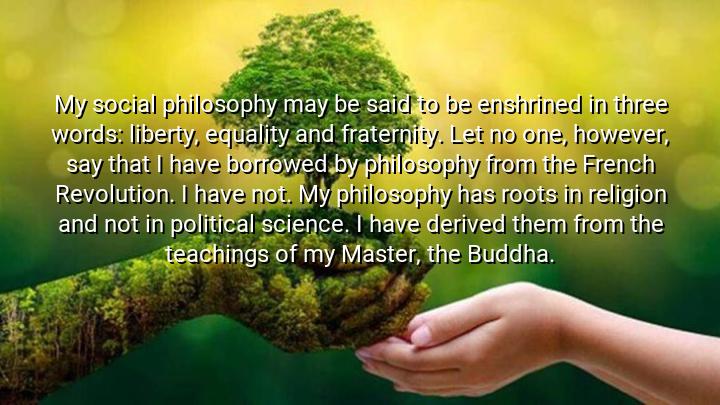




B. R. Ambedkar's quote expresses the core of his social philosophy, which is centered around the principles of liberty, equality, and fraternity. He clarifies that these values, though often associated with the French Revolution, are not borrowed from political movements but rather have deep roots in religion, specifically the teachings of Buddha. Ambedkar, a leading figure in the fight for social justice in India, sought to apply these ideals to his vision of an equitable society, one where individuals are treated with dignity and respect regardless of their caste or background.
Ambedkar’s statement emphasizes that his philosophy is not purely political but spiritual, grounded in the ethical and moral teachings of Buddhism. He rejected the political interpretations of liberty and equality, asserting that true freedom and equality come from inner transformation and spiritual awakening, not just through political or legal reforms. His belief in fraternity, or brotherhood, reinforces the idea that a just society must be one where people live in harmony, united by shared values and mutual respect, rather than division.
The origin of this quote lies in Ambedkar’s personal and intellectual journey as a Buddhist reformer, politician, and activist. After converting to Buddhism, Ambedkar sought to establish a system that would uplift the untouchables and other marginalized groups in India, giving them the rights and opportunities that had long been denied to them under the Hindu caste system. He drew on Buddhism as a moral and ethical framework for his views on equality, rejecting the rigid caste hierarchies and the social discrimination they perpetuated.
Ultimately, Ambedkar's quote highlights his vision of a society based on universal values of justice and human dignity, inspired by his understanding of Buddhist teachings rather than by Western political philosophies. It shows his commitment to creating a more just and inclusive society through both spiritual and social transformation, emphasizing that freedom, equality, and fraternity are not just political ideals but moral imperatives that must be lived out in everyday actions and beliefs.

AAdministratorAdministrator
Welcome, honored guests. Please leave a comment, we will respond soon