

To send light into the darkness of men's hearts - such is the duty of the artist.
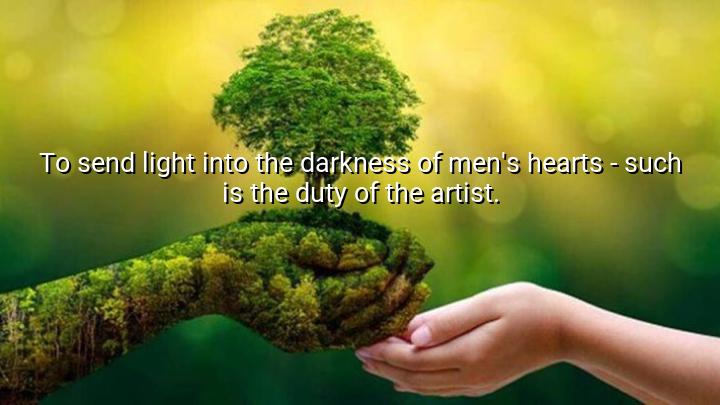




The quote "To send light into the darkness of men's hearts – such is the duty of the artist" by Robert Schumann reflects the profound responsibility that the artist has in transforming the emotional and spiritual landscape of society. Schumann, a German composer and music critic, believed that art had the power to illuminate and elevate the human experience. The light represents hope, understanding, and emotional clarity, while the darkness symbolizes confusion, suffering, or despair. The artist, in this view, has the sacred duty to bring light to those areas of life that are obscured or troubled, helping to guide and inspire others.
Schumann's words suggest that the role of the artist goes beyond mere entertainment or decoration. Instead, the artist is a guide or healer, using their work to provide insight and emotional relief. Whether through music, painting, writing, or any other medium, art has the ability to touch the hearts of individuals, offering them a sense of comfort, clarity, or inspiration in difficult times. This duty is both noble and challenging, as it requires the artist to connect with deep, often unspoken, aspects of human experience.
The artist's role, as Schumann sees it, is not just to create something beautiful but to engage with the emotional and spiritual needs of humanity. By sending light into the darkness, the artist provides a means of emotional transformation, helping people to see the world and themselves in a new light. This concept aligns with Schumann’s own musical compositions, which often sought to evoke deep emotions and provide a sense of catharsis for the listener.
Ultimately, Schumann’s quote underscores the belief that art is a tool for enlightenment and emotional healing. The artist has the unique power to reach into the darkness of human experience and bring forth light, guiding others toward a more hopeful and introspective understanding of life. In this sense, art becomes a moral and emotional endeavor, with the potential to uplift and transform.

XVXinh Vu
Schumann’s statement paints the artist as a sort of spiritual guide. But is it fair to place such a heavy responsibility on artists? What happens when artists choose to create works that don’t explicitly aim to ‘enlighten,’ but instead focus on personal exploration or expression? Can those works still serve a similar purpose in guiding people through their own darkness, even without intention?
YXNguyen Yen Xuan
This idea of sending light into the darkness makes me wonder about the role of art in addressing human suffering. Can art really heal or transform the heart? What if the artist doesn’t consciously aim to provide light, but the work still ends up offering comfort or insight? How much does an artist’s intention matter in fulfilling this 'duty' to their audience?
THHuynh Thanh Huy
Schumann seems to be saying that art is a tool for transforming the heart. Does this mean that art must always have a purposeful message or intention behind it? Can we still appreciate art that doesn't aim to ‘enlighten’ or ‘educate’? Is there a danger in expecting artists to always use their work as a moral guide, or should art remain free from such burdens?
NVKhanh Ngoc Vu
This quote implies that artists have a moral duty to bring light, perhaps meaning understanding, hope, or truth, into the darker aspects of human experience. But how does an artist know what darkness to address? Can their work inadvertently cast light in the wrong direction, or is the role of the artist to simply create and let the audience interpret the light they shine?
B806 Huynh Gia Bao 8A
Schumann's idea that the artist's duty is to ‘send light into the darkness of men’s hearts’ is a powerful one. It suggests that art is not just a personal expression, but a form of service to humanity. But is this always the responsibility of the artist? Can art be purely for the sake of beauty or self-expression, or should it always aim to enlighten or uplift others?