

To me, photography is an art of observation. It's about finding something interesting in an ordinary place... I've found it has little to do with the things you see and everything to do with the way you see them.
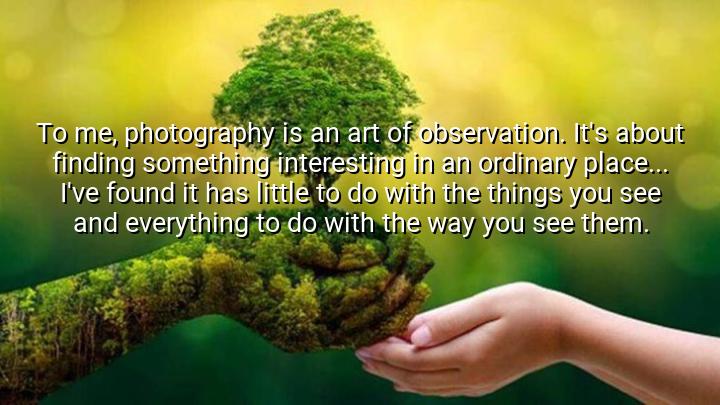




Elliott Erwitt’s quote, "To me, photography is an art of observation. It's about finding something interesting in an ordinary place...", emphasizes the idea that photography is not just about capturing images, but about the art of observing the world in a unique way. Erwitt, a renowned photographer known for his candid and often humorous shots, suggests that what makes a photograph compelling is the ability to see beauty or significance in the most ordinary surroundings.
He goes on to explain that photography is more about the perspective of the photographer than the actual subject being captured. By stating, "I've found it has little to do with the things you see and everything to do with the way you see them," Erwitt highlights the subjective nature of photography. It’s not merely about the objects or scenes being photographed, but how the photographer perceives and interprets them. Creativity lies in the ability to transform the mundane into something extraordinary through the lens of the camera.
Erwitt’s quote also reflects his own approach to photography, which often focuses on the unnoticed or overlooked moments in everyday life. His work demonstrates how observation is key to finding meaning in the simplest of scenes, often revealing humor, irony, or human connection. For Erwitt, the art of observation requires attentiveness to details that others might miss, turning the ordinary into something memorable.
Ultimately, the quote encourages photographers to shift their focus from just what is seen to how it is seen. It suggests that the true art of photography lies in the unique vision of the photographer, encouraging a deeper engagement with the world around them. Through this lens, photography becomes not just a technical skill, but an ongoing practice of seeing the world with fresh eyes.

LNle nghi
It’s interesting to hear a photographer say it’s not about the subject, but about how you see it. That really flips the focus from technique to perspective. But do you think that approach risks being too subjective? I mean, is there a limit to how much personal perception can elevate something ordinary before it becomes just another snapshot? Where’s the balance between seeing differently and just seeing what you want to see?
ALThuy Anh Le
This quote makes me think about how often I overlook beauty in everyday settings. Do you think that applies beyond photography? Like in writing, painting, or even how we interact with people? It’s kind of profound to think that changing the way we see something can totally alter its meaning or value. I’d love to hear thoughts on how this mindset could be applied outside of the visual arts.
TTHuynh Truong thanh
I love the humility in this quote—it implies that the magic is already out there, we just need to see it. But how do you train yourself to observe like that? Especially when the pace of daily life often pushes us to overlook the ordinary. Is observation a skill that photographers actively develop, or does it come from a certain mindset—maybe even a form of mindfulness?
BLPham Bao Linh
Elliott Erwitt's perspective feels so freeing—it makes photography sound less about expensive gear and more about attention and presence. But then I wonder, in the age of social media filters and AI-generated imagery, is this kind of observational photography losing value? Do people still appreciate the subtle, ordinary moments, or are we being conditioned to only react to dramatic or heavily edited visuals?
KLkhanh linh
This quote really challenges how I think about creativity. If photography is more about perception than the subject, does that mean anyone can be a photographer if they just train their eye to notice differently? Or is there something innate in certain people that lets them find beauty in the mundane? I'm curious how much of this ability comes from experience versus natural sensibility. Can it truly be taught?