

To an engineer, good enough means perfect. With an artist, there's no such thing as perfect.
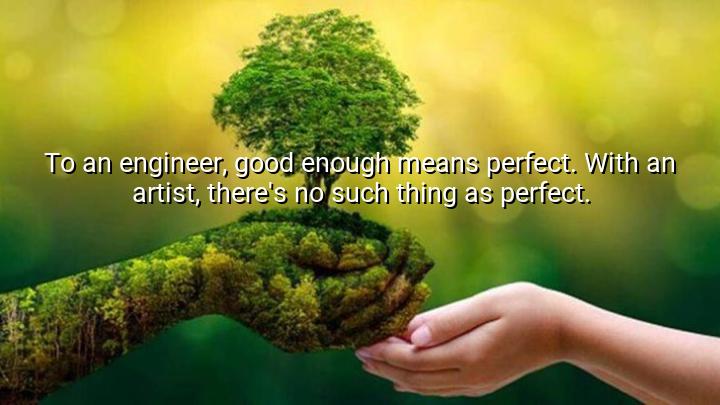




The quote "To an engineer, good enough means perfect. With an artist, there's no such thing as perfect" by Alexander Calder contrasts the differing perspectives on perfection in engineering and art. Calder, an American sculptor best known for his mobiles and large-scale sculptures, suggests that engineers, whose work often prioritizes functionality and precision, are content with something being "good enough" to meet the required standards. For an engineer, the goal is efficiency, and once a design or solution works well enough, it can be considered perfect for its purpose.
In contrast, artists view perfection differently. For them, art is an ongoing process of exploration, expression, and experimentation. Art does not have a fixed or final standard of perfection; it evolves and changes as the artist’s vision develops. An artist may see their work as never truly finished, always open to refinement, reinterpretation, or change. Perfection, for the artist, is a fluid concept that doesn’t exist in a final, unchanging form but is something continually pursued through creative expression.
Calder’s quote highlights the contrast between the precision required in engineering and the freedom in artistic expression. Engineers are often working within defined constraints, aiming for practical solutions that work in the real world, while artists embrace the uncertainty and subjectivity of art. Art is not about meeting a specific, measurable standard of perfection but about pushing boundaries, challenging norms, and expressing personal or universal truths, even if they don’t conform to a traditional sense of perfection.
Ultimately, Calder’s quote emphasizes the unique nature of art in comparison to technical fields like engineering. Artists are driven by their vision and creativity, where perfection is not a goal but a journey of self-expression and discovery. For artists, the process is just as important, if not more so, than the final outcome, which contrasts with the often results-driven mindset of the engineer.

LNLinh Nguyen
I think Calder’s observation holds a lot of truth, but it also makes me wonder how each field deals with mistakes. In engineering, a flaw could lead to failure or danger. In art, a 'mistake' might become the most expressive or compelling part of the piece. Do you think that’s why perfection feels so rigid in one realm and so fluid in the other? What happens when an engineer starts thinking like an artist—or vice versa?
LHTran Lan Huong
Calder’s quote really speaks to how different the motivations are behind engineering and art. Engineers are often judged by how invisible their work is—things just work. Artists, on the other hand, might aim to make us feel something, even discomfort. But I wonder, in a world that increasingly values creativity in tech and precision in art, are these boundaries as solid as they used to be? Or are they blending more than we admit?
MDMyx Duynn
Reading this, I can’t help but ask—why do artists reject the idea of perfection altogether? Is it because art is so subjective that perfection becomes meaningless? Or is it more about the emotional experience of creating, where flaws are embraced as part of the story? On the flip side, can an engineer afford to take that approach when lives or systems depend on precision? It’s a striking contrast between freedom and responsibility.
HHHoangg Hann
This makes me think about how different fields define success. For engineers, functionality is the goal, so once something works safely and reliably, it’s 'done.' But for artists, the process seems endless—like there's always more to tweak, discover, or feel. I’m curious, though—can this mindset be draining? If artists never reach a sense of completion, do they struggle more with self-doubt or creative burnout compared to engineers?
BDBanh Do
I find this quote fascinating because it captures such a clear distinction between two mindsets—practicality versus pursuit. But I wonder, is the gap between engineering and art really that wide? In today’s world, disciplines are overlapping more than ever—think of design engineers or digital artists who work with code. Can we really say perfection is a fixed concept for one and unattainable for the other? Or is Calder being a bit idealistic here?