

Thou must be emptied of that wherewith thou art full, that thou mayest be filled with that whereof thou art empty.
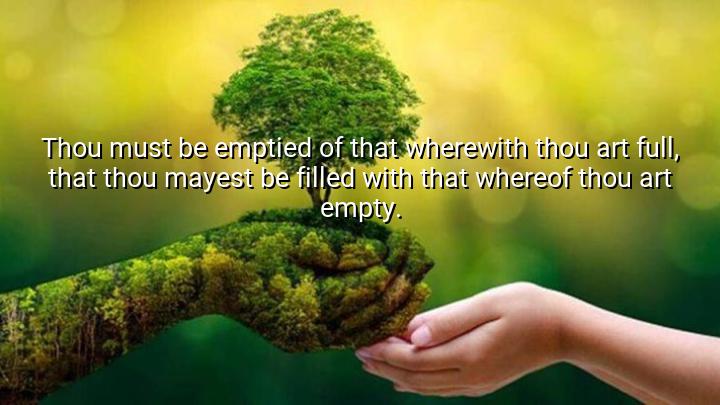




The quote "Thou must be emptied of that wherewith thou art full, that thou mayest be filled with that whereof thou art empty" by Saint Augustine conveys the idea that personal growth and enlightenment require letting go of preconceived notions or distractions in order to make space for something new. To be truly open to new knowledge or experiences, one must first empty themselves of the prejudices, assumptions, or emotions that fill their minds, as these can block true understanding and transformation.
The emptiness referenced in the quote is not seen as a negative void, but rather as an opportunity for renewal and change. By relinquishing outdated beliefs or burdens, individuals create room for the more profound or enlightening truths and wisdom that may come their way. This process allows one to be filled with new insights, perspectives, and virtues that can lead to personal evolution.
Saint Augustine, a renowned philosopher and theologian, often explored themes of self-reflection and spirituality in his writings. His teachings emphasized the importance of humility and inner transformation in the pursuit of a deeper connection with the divine. This quote reflects his belief that true spiritual growth and moral development are rooted in the ability to let go of the self and become receptive to higher callings.
In essence, this quote encourages a process of inner cleansing or detachment, where one frees themselves from the distractions and burdens of the past to make way for meaningful growth and fulfillment.

TLdinh thi ly
This quote has such a meditative quality—it invites deep introspection. It reminds me of mindfulness practices that encourage you to 'let go' of attachments to be more present. Do you think Augustine’s idea aligns with Eastern philosophies like Buddhism or Taoism? It’s interesting to consider how different spiritual traditions echo this theme of creating space within the self in order to receive something greater.
LDLoi Dinh
Saint Augustine's insight here feels like a call to humility. It’s like he’s telling us we can’t be taught or changed unless we first admit we don’t already have all the answers. That’s a hard mindset to adopt, especially in a culture that values certainty and confidence. How can we cultivate the courage to be 'empty' without feeling weak or directionless in the process?
TSTan Sang
There's something unsettling yet beautiful in this message. It speaks to the idea that fulfillment requires sacrifice, or at least a shedding of what's no longer useful. In practical terms, though, what does that look like in daily life? Is it about decluttering our routines, emotions, or even social circles? How can we apply this spiritual principle in a world obsessed with accumulation?
PBPhuong Bui
I find this idea spiritually profound. It makes me think about the paradox of surrender—how releasing control can make space for something more meaningful. But I’m curious: can this kind of 'emptying' be practiced intentionally, or does it tend to happen through life’s difficult, often painful experiences? Is true transformation something we choose or something that happens to us when we’re forced to let go?
BLLe Ba Lam
This quote from Saint Augustine feels incredibly relevant to modern life. It suggests that personal growth requires letting go—whether that’s ego, fear, or outdated beliefs. But how do we know what we need to release? Sometimes what we’re 'full' of feels essential to our identity. How can we discern whether something is actually holding us back, or if it’s something we just need to understand better?