

There hasn't been any art yet. Art is just beginning.
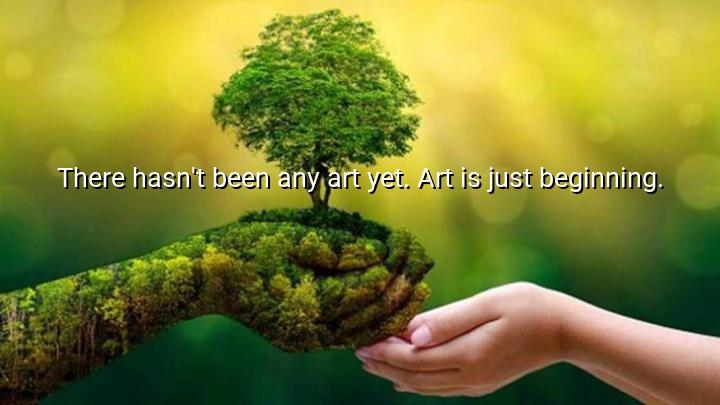




The quote "There hasn't been any art yet. Art is just beginning" by Constantin Brancusi expresses the idea that art is in a constant state of evolution, and the most profound and innovative creations are still to come. Brancusi, a Romanian sculptor who played a key role in the development of modernism, believed that art was not a fixed entity but rather an ongoing journey of discovery and transformation. By stating that art is "just beginning," he implies that true art has not yet been fully realized and that future generations of artists would continue to push boundaries and redefine what art could be.
Brancusi's view on art reflects his commitment to simplifying and distilling forms to their essence. His works, such as Bird in Space and The Kiss, were radical in their abstraction, focusing on the core essence of shapes and forms rather than realistic representation. His statement suggests that while art may have existed in various forms throughout history, the true potential of art—its most pure and impactful expressions—was still unfolding. He saw the evolution of art as a continual process, with the best yet to come.
This quote also aligns with Brancusi’s belief in the infinite possibilities of art. By claiming that art was "just beginning," he challenged the notion that art had reached its pinnacle in any particular era. He advocated for a vision of art that was not bound by tradition or convention, one that could constantly renew itself and take on new forms. His statement reflects his desire to inspire artists to keep pushing forward and to view art not as something that has been completed, but as an ever-evolving field.
Ultimately, Brancusi’s quote serves as both a reflection on the current state of art in his time and a call to artists to continue seeking new forms of expression. It reinforces the idea that art is not static but a dynamic, unfolding process that holds endless potential for innovation and discovery. Through this perspective, art becomes a lifelong journey of exploration, always looking ahead to new possibilities rather than being confined by the past.

TNTran Ngoc
This quote sounds like it’s meant to spark conversation—or controversy. If art is only just beginning, does that mean we’ve misunderstood what art is supposed to do until now? Maybe Brancusi is redefining art as a spiritual or metaphysical practice rather than a representational one. Still, I can’t help but question: is it productive to disregard the past entirely in the pursuit of innovation? Or is that how transformation happens?
HHchau he he
I can’t tell if this is revolutionary or revisionist. Brancusi was obviously part of a huge artistic shift, but claiming that art hadn’t even begun feels like a rejection of centuries of creativity. Does that mean Renaissance art, Indigenous art, or ancient sculpture were just preludes? It’s a powerful statement, but also one that feels culturally narrow if taken literally. What was he really trying to push us to reconsider?
TLPhan Thi Thanh Lam
This quote feels a bit arrogant at first glance, but also strangely hopeful. Maybe Brancusi believed that each new generation of artists has the chance to redefine art from scratch. That’s kind of empowering. But does it imply that everything before him lacked value or originality? I wonder if this perspective encourages progress, or risks ignoring the foundations that modern art is built on.
HLHanh Le
I'm fascinated by this idea. It makes me think about what Brancusi considered 'real' art. Was he drawing a line between craft and conceptual innovation? Or perhaps between representation and essence? It’s such a sweeping statement that it raises more questions than it answers. I’d love to know if he was speaking from a philosophical stance—maybe seeing art as a never-ending process rather than a static tradition.
KAle hoang ky anh
This quote really surprised me—it's such a bold thing to say considering how much art history came before Brancusi. Is he rejecting all previous forms of art, or is he saying that true artistic expression is only just beginning to evolve? Maybe he saw traditional art as too bound by imitation and believed that abstraction was the first real creative leap. Still, it feels almost dismissive. Was this just provocation or genuine belief?