

There are no contests in the Art of Peace. A true warrior is invincible because he or she contests with nothing. Defeat means to defeat the mind of contention that we harbor within.
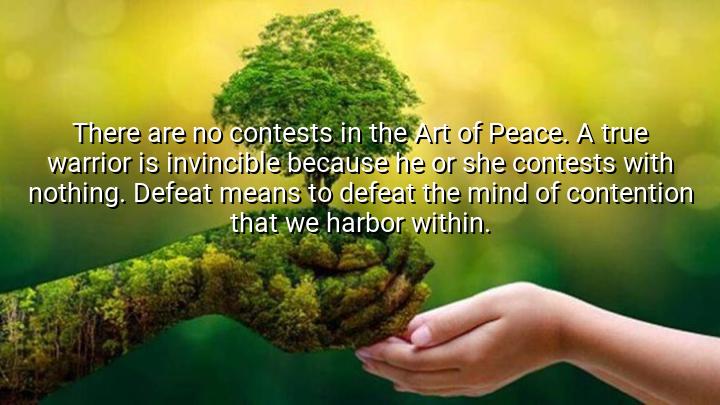




The quote "There are no contests in the Art of Peace. A true warrior is invincible because he or she contests with nothing. Defeat means to defeat the mind of contention that we harbor within" by Morihei Ueshiba reflects the philosophy of Aikido, a martial art that emphasizes harmony, peace, and overcoming inner conflict. Ueshiba, the founder of Aikido, suggests that the true strength of a warrior lies not in physical combat, but in the ability to transcend competition and conflict, both externally and internally.
By stating "there are no contests in the Art of Peace," Ueshiba is emphasizing that peace is not achieved through fighting or competition but through the elimination of hostility and the embracing of unity. A true warrior, in this context, does not engage in struggles with others, but seeks to resolve conflict peacefully, making them invincible in a sense that they are free from the desire to defeat others. Their power comes from within, not from external victories.
The second part of the quote, "Defeat means to defeat the mind of contention," highlights Ueshiba’s belief that the greatest battle is the one within our own minds. Defeat is not about being physically overpowered, but about surrendering to internal negativity, such as anger, hatred, and competition. True victory lies in mastering these negative emotions and finding inner peace.
Ueshiba's philosophy draws from spiritual principles and aims to create a world where violence and discord are replaced by understanding and compassion. This quote reflects his belief in the transformative power of peace and the strength found in overcoming the ego and contentious thoughts. For him, the path to mastery in any discipline, especially in martial arts, is as much about mental discipline and spiritual growth as it is about physical ability.

QNTran Quynh Nhu
I wonder if this perspective is universally applicable or more aligned with Eastern philosophies. In Western culture, we often idolize competition and view peace as passive. But here, peace is framed as an active, even warrior-like pursuit. It’s fascinating to consider: can true strength come not from opposition but from surrendering the need to oppose? I think this could be deeply transformative if widely understood.
CLPham Cam Linh
There's something poetic yet paradoxical about this idea. No contests in the Art of Peace—yet we call the one who follows it a 'warrior.' Is that contradiction intentional to highlight balance? Perhaps Ueshiba is redefining what it means to fight—not against others, but against the need to fight at all. I'd love to hear how martial artists or meditators interpret this in practice.
RCRyen cutes1tg
This quote made me pause and reflect on my own mindset. I never thought of 'defeat' as something internal. I always saw it as something external, like losing to someone or failing at something. But now I’m wondering—how much of my struggle is really with others versus with myself? Do I keep feeding this internal battle unnecessarily? I think Ueshiba is nudging us to transcend our egos.
THvu thi hai
I'm curious how this philosophy applies in a world filled with constant competition—whether in sports, business, or personal relationships. How can we realistically aim to be 'invincible' by contesting nothing when everything seems to demand assertiveness and victory? Is it possible to live by this peaceful warrior ethos without becoming passive or being taken advantage of in a competitive society?
YDYen Doan
This quote really challenges the modern concept of strength. We often associate power with dominance or victory over others, but here, Ueshiba links true invincibility to inner peace. Can someone really be a 'warrior' in the absence of external conflict? I find this idea both calming and revolutionary. It flips the narrative—suggesting that self-mastery and the dissolution of ego might be the highest form of strength.