

The task of art today is to bring chaos into order.
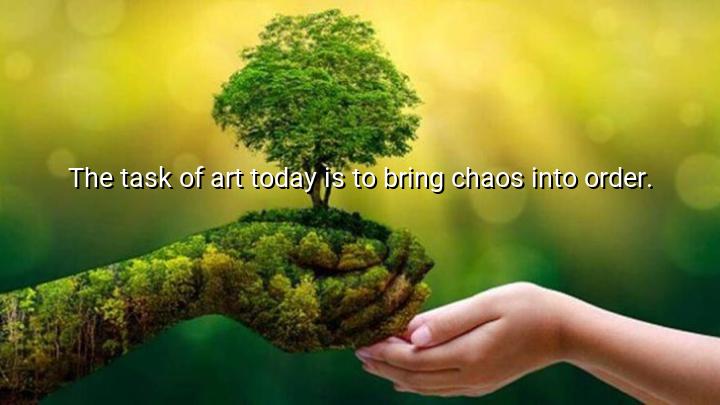




The quote "The task of art today is to bring chaos into order" by Theodor W. Adorno reflects his perspective on the role of art in the modern world. Adorno, a German philosopher and sociologist, suggests that art should function as a tool for making sense of the turmoil and confusion that characterize contemporary society. In a world marked by rapid change, social unrest, and intellectual fragmentation, art serves as a means of restoring harmony and coherence, offering structure and understanding amidst the disorder.
Adorno's view emphasizes the ability of art to confront and address the complexities of the modern experience. Art does not shy away from the chaotic, often troubling aspects of life; instead, it works to bring clarity and meaning to them. By transforming the raw, chaotic elements of society into a structured artistic expression, artists can help viewers understand and navigate the complexities of the world. Art thus becomes a way of interpreting and organizing experience, providing a sense of order in the midst of confusion.
This quote also speaks to the evolving role of art in the 20th century. In the face of modernity's challenges, art was seen as a way to respond to the disorienting effects of industrialization, war, and social upheaval. Artists began to experiment with new forms, materials, and approaches, reflecting the fragmented nature of contemporary life, while at the same time seeking to create meaning and coherence out of this fragmentation. For Adorno, art plays a critical role in helping society make sense of its disordered state and find ways to reorder it in a meaningful way.
Ultimately, Adorno’s quote highlights the dynamic and restorative power of art. Rather than merely reflecting the world, art has the capacity to shape and reframe it, offering order and understanding in an otherwise chaotic and fragmented reality. Artists, in this view, become crucial figures in helping society understand and cope with the complexities of modern life, giving us tools to create meaning from the disorder that surrounds us.

BNBao Nhat
Adorno's view intrigues me, but I wonder if it assumes that chaos is inherently negative or something that needs to be tamed. What if art’s job is not to bring chaos into order but to reveal the meaning inside chaos itself? Maybe the real task is helping us sit with uncertainty instead of solving it. Do you think this quote underestimates the value of ambiguity in art and life?
UGUser Google
This quote struck a nerve for me. There’s a deep beauty in the idea that art can help us understand the messiness of life. But what kind of order are we talking about—emotional, aesthetic, moral? I’d love to know how Adorno defined this ‘order’ and whether he believed it was something universally attainable through creative means. Can every artist embrace this task, or is it more of a philosophical challenge than a practical one?
LNLinh Nguyen
Adorno’s words suggest a pretty demanding task for art. Isn’t it asking too much to make sense of chaos? Sometimes, chaos is so personal or political that ‘order’ feels almost oppressive. Does this mean art should simplify, or is it more about transformation—turning emotional or social unrest into something people can engage with? And if that’s the case, who decides what the ‘order’ should look like?
NXVu Nguyen Xuan
I find this quote intellectually provocative. But I can’t help wondering—is it even possible to bring chaos into order without losing the essence of that chaos? Some of the most powerful artworks I’ve seen don’t try to organize anything—they lean into disorder, making you feel discomfort or confusion. Could Adorno be suggesting that art should offer clarity in the midst of uncertainty, or is that just an idealistic view of its role?
TNThanh Nguyen
Adorno’s quote feels timely, especially in a world where everything—from politics to social media—feels overwhelmingly chaotic. But what does it really mean to bring chaos into order through art? Is the artist supposed to resolve disorder, or simply give it shape so we can understand it better? I’m curious whether he saw this as a responsibility or a possibility. Can art actually impose structure on something as vast and emotional as chaos?