

The supreme art of war is to subdue the enemy without fighting.
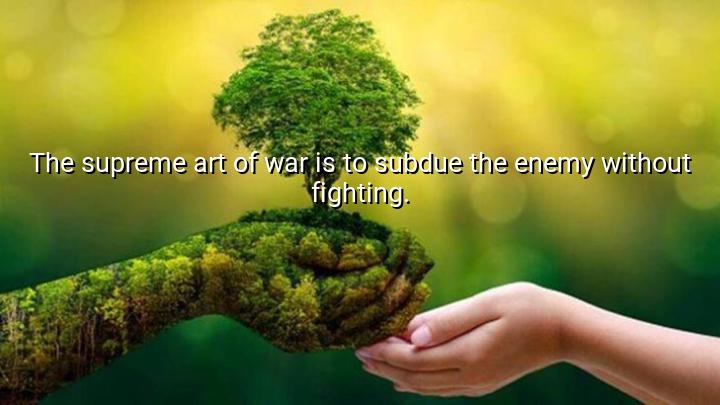




In this quote, Sun Tzu highlights the supreme art of war—the ability to defeat an enemy without engaging in actual combat. The core idea is that true mastery in war lies not in physical confrontation, but in strategy and psychological warfare. Sun Tzu advocates for achieving victory through tactics that undermine the enemy's resolve, weaken their position, or make them surrender without the need for direct violence. This concept focuses on outsmarting the opponent rather than overpowering them.
The origin of the quote comes from Sun Tzu’s renowned military treatise, The Art of War, written in ancient China. This text has influenced not only military strategy but also areas like business, leadership, and politics. Sun Tzu’s philosophy emphasizes the importance of preparation, knowledge, and deception in warfare. His teachings argue that avoiding unnecessary conflict is the hallmark of an accomplished leader or strategist.
Sun Tzu's philosophy goes beyond literal warfare and is often applied to conflict resolution in various aspects of life. The idea of subduing an enemy without fighting suggests the power of negotiation, diplomacy, and psychological influence. By weakening the enemy through non-violent means, such as turning them against each other or convincing them to yield, one can avoid the cost and destruction that comes with battle.
Ultimately, the quote serves as a powerful reminder of the importance of strategy over brute force. It suggests that the most effective leaders and warriors are those who can achieve their objectives through intelligence and subtlety, making conflict unnecessary and ensuring a more sustainable, peaceful outcome.

UGUser Google
Honestly, this quote feels both ancient and incredibly modern. In an age where cyberwarfare, sanctions, and information control can cripple a country without a single bullet, Sun Tzu's insight seems prophetic. But it also raises concerns: is a silent war less damaging, or just more insidious? How do we measure harm when it’s not immediately visible, and who holds accountability in these less tangible forms of conflict?
TNNguyen Thi Tuyet Nga
From a leadership perspective, this quote is brilliant. It suggests that the ultimate form of control is one where conflict is resolved before it escalates. It makes me think of corporate competition—could this philosophy translate into leadership styles that prioritize influence and foresight over confrontation? And if that’s the case, why do so many leaders still favor aggressive tactics instead of building cooperative or deterrent strategies?
B6Le Van Binh 6A6
I find this quote unsettlingly wise. It reframes war as more of a mind game than a battlefield. Does this mean true power lies in influence and perception rather than weaponry? If so, how do we ethically wield that power? This opens up difficult questions about manipulation, propaganda, and coercion. Where’s the line between strategic superiority and moral compromise when avoiding a fight becomes the primary objective?
T6Vay Ngoc Thanh Tam 6a5
Reading this makes me question the value we place on brute force and direct confrontation. If the most effective victory is one that avoids bloodshed, why does society still glorify war heroes over peace negotiators? I’d love to hear perspectives on how this philosophy plays out in real-world conflicts. Is it idealistic, or is it actually the height of pragmatism to win through strategy rather than destruction?
NHDang Thi Ngoc Huyen
This quote has always intrigued me. It feels almost paradoxical—how can one win a war without actual combat? Is it about psychological strength, strategic brilliance, or perhaps diplomacy? It challenges the traditional view of victory as something earned through force. I wonder how applicable this idea is in modern contexts like politics or business. Can peaceful resolution truly be considered victory in competitive environments that often reward aggression?