

The most beautiful thing we can experience is the mysterious. It is the source of all true art and science.
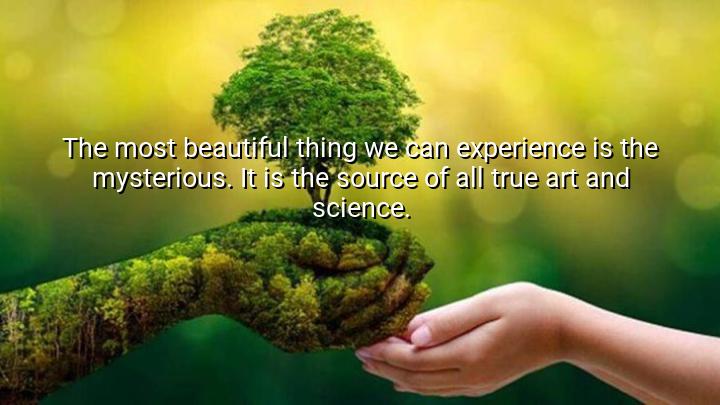




In this quote, Albert Einstein speaks to the profound importance of the mysterious in both art and science. He suggests that the most beautiful and inspiring aspect of life is the unknown—the elements of existence that remain beyond our understanding. For Einstein, it is this sense of mystery that drives human curiosity, creativity, and exploration, fueling both artistic and scientific endeavors. The unknown, rather than being something to fear, is seen as a source of inspiration and discovery.
Einstein's view connects the realms of art and science, recognizing that both fields are motivated by the desire to explore and understand the world, often through a process of grappling with the mysterious. Artists express the mystery of human experience and the world around them through creative work, while scientists explore the mysteries of nature and the universe through inquiry and experimentation. In both cases, it is the unanswered questions and the pursuit of understanding that drive progress and innovation.
The phrase "the source of all true art and science" highlights how the quest to explore the unknown leads to groundbreaking discoveries and profound creative expressions. For artists, the mystery of the human condition, emotions, and existence often leads to new forms of expression and connection. For scientists, the mysteries of the natural world lead to theories, inventions, and advancements that expand our understanding of the universe.
Ultimately, Einstein’s quote emphasizes the shared inspiration that both art and science draw from the mysterious. By embracing the unknown, both artists and scientists engage in a form of exploration that transcends boundaries and leads to new ways of understanding, creating, and experiencing the world. It suggests that mystery is not just something to be solved but something to be cherished, as it drives much of the creativity and discovery that shape our lives.

GPNguyen Hoang Gia Phap
This quote got me thinking—do we lose something essential when we try to dissect art or science too much? Sometimes I feel like over-analysis kills the magic. Maybe Einstein is urging us to embrace that initial spark of wonder instead of trying to conquer it right away. Should we be creating space in our daily lives to simply sit with the unknown, without needing to define it?
DTHau Do Thi
I really resonate with this. It reminds me of that childlike awe we lose as we get older. It’s ironic that someone as scientifically minded as Einstein would put mystery above explanation. Does that mean we should cherish what we don’t understand just as much as what we do? What do you think this says about the role of intuition or emotion in scientific and artistic processes?
MNPhan Minh Nhut
There's something poetic about Einstein tying beauty to mystery. As a reader, it makes me pause—can we even create meaningful art or discover new science without being drawn to the things we can't explain? It’s like mystery is the spark. But then I wonder, where’s the balance? Can too much mystery become paralyzing instead of motivating? How do we move forward without needing to solve everything all at once?
TAThuy An
This makes me think about how tightly linked imagination and intellect are. Is Einstein implying that mystery is a necessary condition for progress in both art and science? I’m intrigued by the idea that mystery doesn't separate these fields but unites them. Do you think modern education systems nurture this appreciation of mystery, or do they train us to eliminate it through rigid problem-solving?
Cchohuy
I find this quote both uplifting and humbling. It suggests that curiosity and wonder—rather than certainty—are at the heart of creativity and discovery. But I wonder, in our world obsessed with answers and efficiency, do we still value mystery? Have we grown too uncomfortable with the unknown to let it truly inspire us? I'd love to know how others tap into the 'mysterious' in their work or life.