

The mission of art is to represent nature not to imitate her.
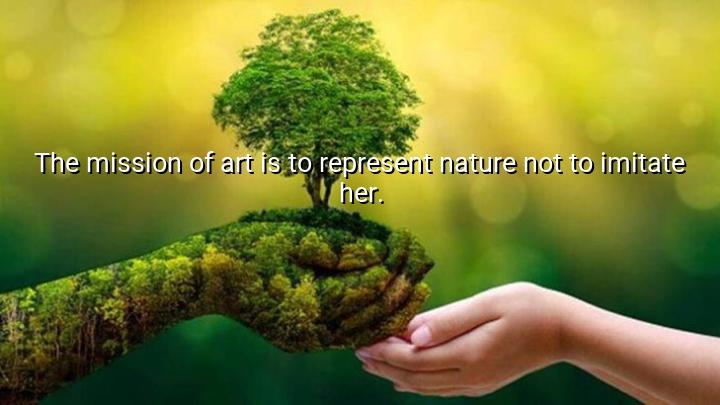




The quote "The mission of art is to represent nature not to imitate her" by William Morris Hunt highlights a key distinction between representation and imitation in the creative process. Hunt suggests that art should not simply copy or replicate the external appearance of nature, but rather seek to represent its deeper essence. The goal is not to reproduce nature in a literal sense, but to capture its spirit, emotions, or underlying truths, offering a more personal and interpretive portrayal.
In this context, to represent nature means to interpret and convey its beauty, complexity, or symbolism in a way that reflects the artist's unique perspective. Instead of focusing on mere duplication, the artist should strive to evoke the same feelings or atmosphere that nature inspires. Hunt believed that true art engages with nature on a more profound level, allowing the artist to express their vision and experience, rather than simply mimicking what they see.
The origin of this quote can be linked to Hunt’s background as a prominent American artist and teacher, who was influenced by the naturalism movement and the French Barbizon school. Hunt’s works often featured landscapes, portraits, and scenes that captured the emotional and atmospheric qualities of nature, rather than adhering strictly to realistic representation. His approach reflected his belief in the power of art to interpret nature in ways that went beyond surface-level imitation.
By stating, "The mission of art is to represent nature not to imitate her," Hunt emphasizes that art has a higher calling than mere replication. It should strive to offer a deeper, more meaningful connection with nature, evoking its emotional or philosophical aspects rather than simply copying its form. This perspective challenges artists to look beyond the visible and to focus on the essence of their subjects, creating works that resonate with both truth and imagination.

NNThi thuy ngan Nguyen
This quote made me reflect on how much subjectivity is involved in artistic creation. If we aren’t meant to imitate nature, then every artistic depiction becomes a statement, a choice, a point of view. But doesn’t that mean two artists could look at the same landscape and produce completely different, yet equally valid works? I’d love to hear thoughts on how this concept plays out in collaborative or community-based art.
KTTran Kim Thoa
There’s a subtle but powerful idea here—that art is more than a mirror, it’s a medium for insight. It makes me think about how artists like Van Gogh or Monet didn’t paint nature 'accurately' but instead captured its energy or essence. But I’m wondering, is there still value in imitation for study or appreciation? Or does that kind of work fall outside what Hunt would consider true 'art'?
TLThuy Linh
This quote challenges a common assumption I had—that great nature art should look as realistic as possible. But now I’m thinking: does striving for imitation limit creativity? Maybe representation allows for mood, metaphor, or even critique. I’d love to know how this perspective shaped Hunt’s own artwork and whether he practiced this idea in his technique or just philosophized about it. Did he paint with this principle clearly in mind?
DDQuynh Diem Dao
I find this statement a bit freeing, honestly. It gives permission to the artist to go beyond visual accuracy and instead focus on emotional or symbolic truth. But where’s the line? When does representation lose its connection to the natural world and become something else entirely? I wonder if Hunt would embrace highly abstract or surreal nature-inspired works, or if he had a more traditional aesthetic in mind.
GDGold D.dragon
I’m curious about what this quote means for modern forms of art like photography. When a photographer captures a natural scene exactly as it is, are they imitating or representing? Can the framing, lighting, or timing transform it into representation rather than pure imitation? This quote makes me question whether the medium itself affects the mission, or if it’s always about the artist’s intention regardless of how literal the work may be.