

The mediator of the inexpressible is the work of art.
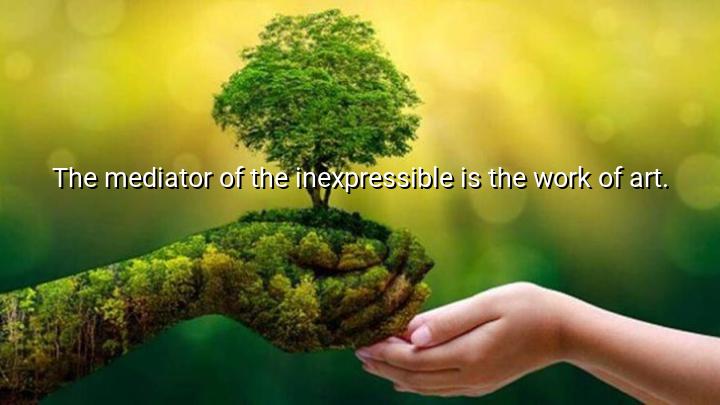




The quote "The mediator of the inexpressible is the work of art" by Johann Wolfgang von Goethe suggests that art serves as a bridge between the unspoken or inexpressible emotions and ideas that lie deep within the human experience and the ability to communicate them. Goethe implies that there are aspects of life—whether profound, emotional, or complex—that words cannot fully convey. Art, in its various forms, has the power to express these inexpressible aspects of the human condition, allowing us to connect with emotions and thoughts that might otherwise remain hidden.
Goethe, a renowned writer and philosopher, understood the limitations of language in conveying deep or complex feelings. His belief that art is the mediator between these ineffable experiences and human understanding highlights the transformative power of creative expression. In his view, art allows us to communicate emotions and ideas that go beyond mere language, transcending words and offering a deeper form of connection.
The origin of this quote stems from Goethe’s broader philosophy on the role of art in human life. As someone who explored the intersections of emotion, reason, and creativity, he recognized that while language might be limited in its ability to express the full spectrum of human experience, art can fill in that gap. Through its form, whether visual, musical, or literary, art is capable of expressing the most complex and abstract elements of human existence.
For artists, this quote serves as a reminder of the importance of their work in conveying the inexpressible. It encourages them to embrace the unique role that art plays in capturing and communicating those deep, often difficult-to-define aspects of life. Goethe’s words invite artists to explore the emotional and intellectual realms that words alone cannot touch, using their medium to mediate the inexpressible and make it accessible to others.

CTCuong Trung
Goethe's thought resonates with how I’ve always experienced art—as a mirror to my most complex emotions. Sometimes, I see a film or read a novel and suddenly feel understood in ways I couldn’t even articulate myself. But it also makes me think: does the ‘inexpressible’ need mediation to have value? Or is it the very mystery of those unspoken emotions that gives them meaning, even without being captured in art?
VQMinh Vo Quoc
I have mixed feelings about this. On one hand, I agree—there are emotions and experiences I’ve had that no words could ever explain, but I’ve seen them reflected in visual art or music. On the other hand, I wonder: can art ever be completely universal in conveying what’s ‘inexpressible,’ or is it always filtered through culture, context, and personal interpretation? Maybe art only mediates what we’re already primed to feel.
NNhien
This quote intrigues me because it elevates the role of the artist to that of a spiritual conduit. If a work of art truly mediates the inexpressible, does that mean it communicates directly with our emotions or even our subconscious? I’d love to hear how different art forms—like sculpture versus dance—might approach this idea differently. Can the medium itself shape what is or isn't 'inexpressible'?
MTMinh Thu
I find Goethe’s idea incredibly moving. It suggests that artists are not just creators but translators of the unseen and unfelt. But it raises a question: can every work of art be a true mediator of the inexpressible, or is it limited by the artist’s own ability to understand what they’re trying to convey? I’m curious how much of that ‘inexpressible’ is shaped by the viewer rather than the artist.
GDGold D.dragon
This quote by Goethe makes me reflect on how art often expresses what words can't capture. Have you ever stood in front of a painting or listened to a piece of music and felt something so profound that it bypassed language entirely? It makes me wonder if art is our most honest form of communication. What happens to human expression if we only rely on language and logic? Do we lose something essential?