

The highest art is always the most religious, and the greatest artist is always a devout person.
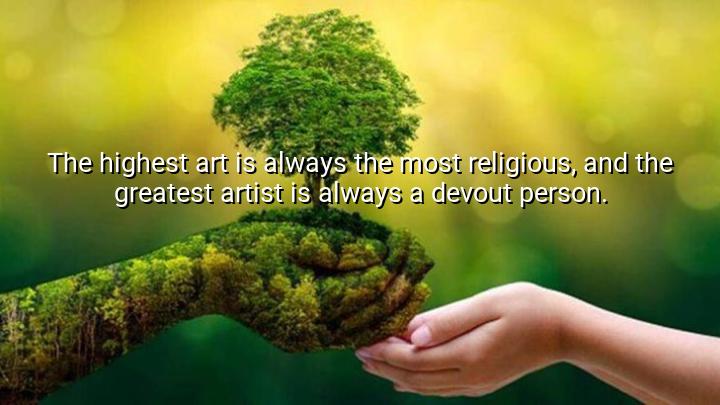




The quote "The highest art is always the most religious, and the greatest artist is always a devout person" by Abraham Lincoln highlights the profound connection between art and spirituality. Lincoln suggests that the most powerful and meaningful art transcends mere technique or aesthetic pleasure; it touches on deeper, universal truths and often reflects the artist's inner sense of devotion or spirituality. For Lincoln, the act of creation, particularly at the highest level, is inherently linked to a sense of reverence or faith.
By describing art as "the most religious," Lincoln implies that true art elevates the soul and connects the viewer or creator to something greater than themselves, whether that be a divine presence, the natural world, or universal truths. This perspective suggests that art is more than just a form of expression; it has the power to inspire and cultivate a sense of spiritual awakening or connection. The greatest art reflects the artist's devotion, both to their craft and to the greater forces or ideals that guide their creative process.
In saying that the greatest artist is a devout person, Lincoln emphasizes the idea that art comes from a place of deep commitment and passion. The most profound works are born out of the artist’s spiritual or emotional connection to their subject matter. Whether through religious themes, personal beliefs, or an overwhelming reverence for life itself, a devout artist channels their devotion into their work, producing creations that resonate on a deeper level.
Ultimately, Lincoln’s quote reminds us that art is not just a mechanical or superficial pursuit; it is an expression of the soul. The highest art speaks to the universal human experience, and the greatest artists are those who approach their work with a sense of reverence, drawing from their own spirituality or deep commitment to their craft. Through this devotion, they create works that resonate with others on a spiritual or emotional level.

TNLuong Thanh Nam
This quote feels like a call to consider the role of spirituality and belief in the creative process. Is it possible to create art that resonates deeply with people if the artist isn’t motivated by something greater than themselves? How much of art’s power lies in its ability to convey universal truths that transcend the individual? Could the most powerful forms of art be a reflection of the artist’s inner faith or spiritual journey?
TBBui Thanh Binh
The idea that the greatest artists are devout makes me think about how personal beliefs can influence creative work. Does a devout artist bring more depth to their art because their inspiration comes from a higher purpose or belief system? Could it be that art becomes more meaningful when it’s created with a sense of spiritual purpose, or can secular art achieve just as much emotional impact without that devotion?
LDNguyen Tran Linh Dan
Lincoln’s statement about the connection between art and religion might raise questions about whether spirituality is truly essential for creating great art. Are there artists who defy this idea, creating masterpieces that are secular or non-religious in nature? And if so, does this invalidate their greatness, or does it simply show that 'devotion' can manifest in different ways—like devotion to humanity, creativity, or even a cause?
TQThanh Quang
I’m curious how this quote aligns with the modern view of art. Does Lincoln mean that to be a great artist, one must be religious in a traditional sense, or does 'devout' refer more to a dedication to the craft, a commitment to truth, or even a kind of philosophical devotion? I’d love to hear more about how people interpret the relationship between spirituality and art in contemporary society.
TNTrieu Ngan
I wonder if Lincoln’s statement implies that art should always have a moral or spiritual dimension. In today’s world, we often see art as an expression of personal experience or cultural commentary. Can art still be considered the highest form of expression if it isn’t inherently religious or devout? What does it say about the artist’s role in society, especially when they don’t align with traditional religious values?