

The great art of life is sensation, to feel that we exist, even in pain.
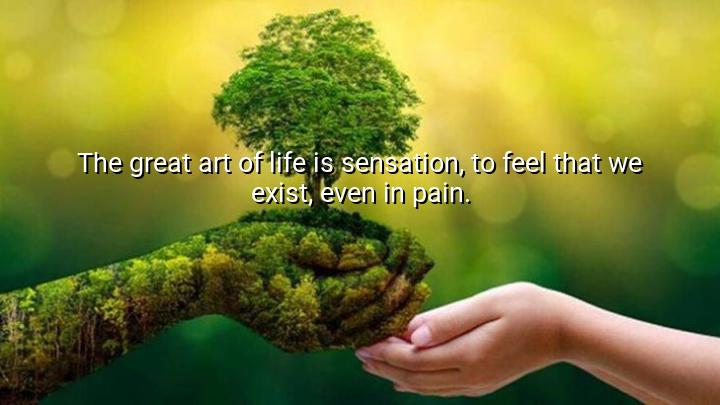




In this quote, Lord Byron emphasizes that the great art of life lies in the ability to experience sensation, the awareness of our existence. He suggests that to truly live is to feel—whether that feeling is one of joy or pain. Byron acknowledges that even pain, with all its discomfort, is an integral part of the human experience, offering a sense of vitality and being. The quote highlights his belief that life’s value is found in our emotional and sensory experiences, which make us feel truly alive.
The origin of the quote comes from Byron’s work as a poet and romantic figure in the early 19th century. Known for his intense emotional expression and exploration of human passion, Byron often delved into themes of suffering, love, and existential longing. This quote reflects the Romantic movement’s focus on the depth of human experience, valuing intense personal feeling over rationality or conventionality. For Byron, living fully meant embracing all facets of life, even the painful ones, as they serve to remind us of our existence.
Byron’s statement also touches on the concept of existential awareness—the idea that to feel deeply, even in suffering, is a sign of life and vitality. Pain, in his view, is not something to be avoided but accepted as part of the human condition. This aligns with Romantic ideas that emotional depth and the exploration of life's challenges are what give it meaning. In this sense, Byron sees sensation as the key to truly appreciating the experience of being alive.
Ultimately, this quote invites us to embrace the full spectrum of human emotion. By acknowledging that sensation, even in its painful forms, is central to feeling alive, Byron challenges us to experience life in its entirety, appreciating both pleasure and discomfort. In this view, the art of life is not just about seeking happiness or avoiding pain but about fully engaging with the richness of our emotional and sensory world.

HNHai Huy Ngo
There’s something beautifully raw about this quote. Byron seems to tap into a deeper truth: that feeling, no matter the flavor, is central to being human. But is that a universal truth or more of a romantic ideal? Can someone find fulfillment in a life of peace and simplicity without intense sensation? I’d be curious to hear how a monk or minimalist might respond to this perspective.
BP31. Bich Phuong
Is Byron implying that numbness or emotional detachment is a greater tragedy than pain itself? If so, that’s a really powerful statement, especially in today’s world where many people struggle with feeling disconnected or lost. It makes me think about how society often medicates or distracts away any sensation that isn’t pleasant. Are we losing something essential by doing that?
DQDiep Dat Quyen
This quote challenges my tendency to avoid discomfort at all costs. Byron seems to suggest that even suffering has value because it confirms that we are truly alive. But is it healthy to embrace pain this way, or could it lead us to tolerate harmful situations longer than we should? I’d love to hear how others interpret this—especially from people who’ve gone through significant hardships.
GLDao Vu Gia Linh
Byron’s words speak to me on a strangely existential level. I’ve often felt most alive during intense experiences, even the painful ones. But why is that? Is there something about discomfort that jolts us out of our numb routines and forces us to be present? It makes me wonder if emotional pain functions similarly—acting as a wake-up call rather than just a torment.
THPhuc Luong tran huy
I find this quote by Byron deeply moving but also a bit unsettling. It makes me wonder: is pain really necessary to affirm our existence? Can't joy, love, or awe offer the same sense of vitality? I get the poetic angle, but I worry that this romanticizes suffering. What about those who endure chronic pain—should they be expected to see it as proof of life? It feels like a philosophical double-edged sword.