

The beauty of a finely worked object points to the beauty of the craftsmanship. The beauty of the craftsmanship points to the beauty of the name which was the source of the craftsmanship. The beauty of the name of the craftsman's art points to the beauty of the craftsman's attributes manifested in that art.
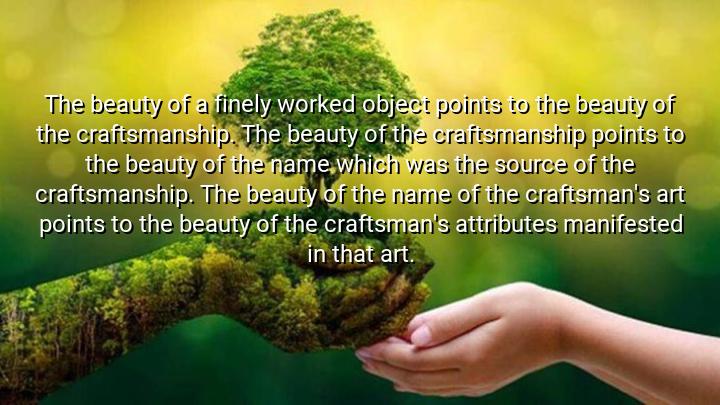




Said Nursi’s quote, “The beauty of a finely worked object points to the beauty of the craftsmanship. The beauty of the craftsmanship points to the beauty of the name which was the source of the craftsmanship. The beauty of the name of the craftsman's art points to the beauty of the craftsman's attributes manifested in that art,” reveals a deeply spiritual and philosophical view of art, creation, and divine reflection. Nursi suggests that when we witness the beauty of an object, it naturally leads us to admire the skill behind it—what he calls the craftsmanship.
As an influential Islamic scholar and theologian in the early 20th century, Nursi often emphasized the importance of recognizing divine signs in the natural world and human experience. This quote reflects his belief that every work of art, whether manmade or found in nature, is a reflection of something greater—a source, a name, and ultimately the attributes of the Creator. Here, the term "name" can be understood in its theological sense, referring to one of the names of God, each representing a divine attribute like wisdom, power, or mercy.
The layered structure of the quote illustrates a chain of meaning: from the visible object, to the invisible skill, to the identity of the artist, and finally to the qualities expressed through that work. This mirrors the way Nursi approached the universe itself—as a beautifully designed object that leads the mindful observer to contemplate the divine artistry behind it. Thus, every piece of beauty in the world is not just an end in itself, but a signpost pointing to a higher truth.
Ultimately, Nursi’s words highlight the profound connection between art, spirituality, and recognition of the divine. Beauty, in this view, is not superficial; it serves a purpose—to guide the soul toward reflection, gratitude, and understanding of the Creator’s attributes through the marvels of creation and human expression.

BNduong bao nhi
What resonates with me here is the idea that beauty doesn’t just stop at the object—it points beyond itself, almost like a spiritual signpost. This raises a deep question: when we admire a masterpiece, are we connecting to something eternal, something divine? Or is this interpretation shaped by cultural and religious context? How much of this appreciation is universal versus learned?
DTDao Truc
The recursive nature of the quote is really striking. It's almost like a philosophical proof built out of aesthetics. But I wonder, could this framework be used to analyze all art forms—music, literature, dance—or is it more about physical craftsmanship? How would you interpret the ‘name’ of a musician’s craft, for example? What would that ‘name’ even be in this metaphor?
DVDung Vu
This perspective feels so different from how art is sometimes viewed today—focused on novelty, concept, or even shock value. Nursi seems to emphasize harmony, beauty, and source. It makes me wonder: has modern art lost touch with this kind of reverence for craftsmanship? And if so, what are we gaining or losing as a culture by shifting our values?
TMTri Minh
Said Nursi seems to be building an argument for divine inspiration or at least a transcendental source of artistic beauty. It raises a question for me—does all meaningful craftsmanship point to something greater, or is that interpretation specific to certain spiritual traditions? Can a secular viewer or maker still access the same depth of meaning without invoking the divine?
TPTrang Pham
I find this quote fascinating in how it almost spiritualizes the act of creation. It implies a chain of beauty, from object to soul. But what if a beautiful object is made through repetition, without much conscious intention? Does the meaning still apply? Is intention required for this kind of transcendent craftsmanship, or is it the final result alone that carries the message?