

The arts are an even better barometer of what is happening in our world than the stock market or the debates in congress.
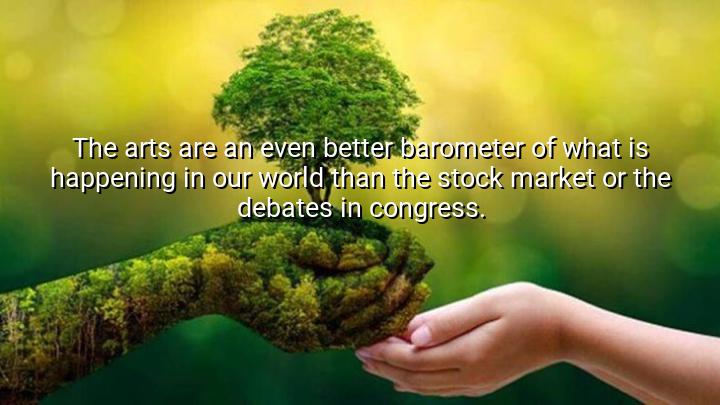




In this quote, Hendrik Willem Van Loon asserts that the arts are a more accurate reflection of societal and cultural shifts than the stock market or political debates. He suggests that art, in its various forms, captures the emotional, psychological, and social currents of a time, providing deeper insights into the state of the world. While the stock market may reflect economic trends and congressional debates may indicate political discussions, art reveals the underlying moods, values, and concerns of the public, often before these issues become widely acknowledged.
The origin of the quote lies in Van Loon’s broader views on culture and its role in shaping and documenting history. As a historian and author, Van Loon recognized that the most significant changes in society are often mirrored in the art produced during a given period. Artists, through their work, respond to the social climate in ways that politicians and economists may not, creating a more personal and nuanced record of the times. Whether through literature, painting, music, or theater, art captures the human experience, offering a lens through which we can understand the broader cultural and societal context.
Van Loon’s comparison between art and the stock market or political debates underscores his belief that economic and political systems can sometimes obscure the more subtle, emotional aspects of a society. While financial and political events can be indicators of change, they often fail to capture the deeper human truths or the collective psyche of a population. In contrast, art communicates these truths in ways that are universally accessible and emotionally resonant, making it a more honest and enduring measure of a society’s well-being.
Ultimately, this quote suggests that the arts offer a holistic and authentic understanding of the world that goes beyond the surface-level metrics of politics and economics. Van Loon’s perspective invites us to look to the creative works of a society for a more comprehensive and nuanced view of what is truly happening in the world, emphasizing that art can reveal both the visible and invisible forces shaping our lives.

HTho tran
I find this quote both insightful and idealistic. The arts can be prophetic, but they can also be escapist or abstract. Not every artist is trying to comment on the state of the world. So how do we differentiate art that serves as a true societal mirror from art that’s purely personal or decorative? Is all art political in some way, or does that put too much expectation on creative expression?
BLBinh Le
This feels especially relevant today. When I think about social movements or global crises, it's usually a powerful image, a mural, a poem, or a song that sticks with me—not a speech in Congress or a stock chart. Art gets to the heart of human experience. Do you think this suggests we should be funding and preserving the arts more aggressively as a societal necessity, not just a luxury?
NTVo Le Ngan Tuyen
I love the poetic truth of this quote. It makes me think about how songs, movies, and paintings often reflect what people are feeling long before news headlines catch up. Remember how post-9/11 art and media captured the fear and uncertainty of that time? I think Van Loon is right: artists respond quickly, and with emotional depth. But how do we make sure that such voices are heard broadly and not just in niche spaces?
NDNhu Ngoc Dang
It’s a compelling idea, but I wonder—can the arts really function as a better indicator of societal conditions than ? Still, I do think that music, visual art, and literature offer insights into cultural tensions that numbers alone can't show. Thoughts on how to reconcile these lenses?
UGUser Google
This statement really resonates with me. I’ve always felt that art captures the emotional and psychological undercurrents of society in ways that politics and economics simply can’t. While the stock market might react to short-term events, and politicians might spin narratives, artists often reveal deeper truths—sometimes subconsciously. Do you think artists have a responsibility to reflect the world around them, or is that just something that happens naturally through their work?