

The artist's world is limitless. It can be found anywhere, far from where he lives or a few feet away. It is always on his doorstep.
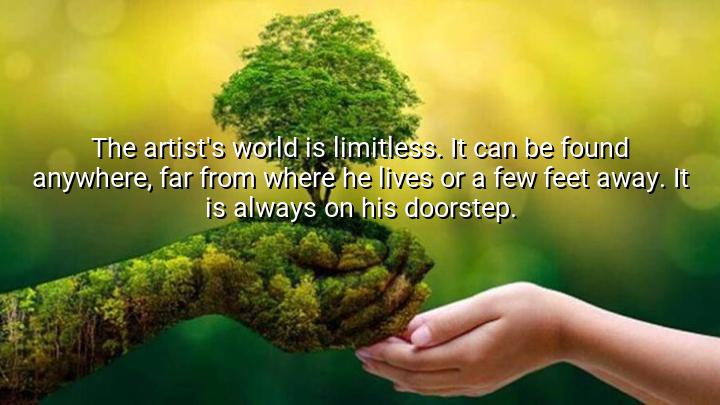




The quote "The artist's world is limitless. It can be found anywhere, far from where he lives or a few feet away. It is always on his doorstep" by Paul Strand emphasizes the idea that the artist's world is not confined by geographical boundaries or external conditions. Instead, it exists wherever the artist is, whether in faraway places or in their immediate surroundings. For Strand, a prominent photographer, the world of an artist is rich with possibilities, and inspiration can be found in both the grand and the ordinary. The artist has the ability to transform any environment into a source of creativity and meaning.
Strand’s statement reflects the notion that art is not limited to specific locations or subjects but can arise from any moment, space, or experience. Whether the artist is traveling to distant lands or simply observing the world around them, the potential for art is always present. This perspective aligns with photography as Strand practiced it—where he often sought beauty and significance in the seemingly mundane aspects of life, transforming ordinary scenes into compelling works of art.
By saying that the artist's world is always on his doorstep, Strand suggests that the key to art lies in perception and attention. Inspiration is not something that can only be found in distant, exotic places but can be seen in the details of the everyday world. For the artist, it is a matter of looking with fresh eyes and seeing the beauty in the familiar. This approach invites artists to embrace their immediate environment and find creative opportunities close to home.
Ultimately, Strand's quote encourages artists to cultivate awareness and openness to the world around them. It suggests that art is not about searching for something far away but about finding inspiration in the present moment, no matter where one is. The artist's world is boundless because it is rooted in the artist's ability to see beyond the surface and recognize the potential for creativity in every corner of their life.

HTHa Trinh
Paul Strand’s statement makes me think about the relationship between observation and imagination. If everything around us holds potential, does that mean the artist’s role is more about framing than inventing? Are artists simply highlighting the beauty and complexity that already exists, rather than creating something entirely new? It’s a powerful reminder of the value of mindfulness and presence in any creative discipline.
DQVu Dinh Quyet
As someone who often struggles with creative blocks, this quote is both inspiring and a little frustrating. If the artist’s world is always close by, then why does it feel so elusive at times? Does this mean I’m just not looking closely enough, or perhaps not in the right way? I’d love to hear how different artists interpret this concept in their practice—especially those in urban versus rural environments.
QTQuynh Th
There’s something comforting in this idea that the artist’s world is ever-present. It reassures me that I don’t have to chase inspiration—it’s already here if I’m open to it. But it also raises a question: what happens when the familiar becomes too familiar? Can artists become desensitized to the beauty around them if they don’t step away from their 'doorstep' every once in a while?
TLTrao Lo
I love the sense of possibility in this quote. It feels like a call to action—like we don't need to wait for the 'right moment' or a 'perfect view' to create something meaningful. But I also wonder if this romantic view ignores the real barriers many artists face, like lack of resources, community, or mental space. Is the world truly limitless for all artists, or is that an ideal more than a reality?
DHDoan Duc Hieu
Strand's quote makes me wonder how much of art is about physical place versus internal mindset. If an artist can find material everywhere, does that mean inspiration is more about attitude than environment? How does this idea relate to artists living in places that are hostile or uninspiring? Can they still access this 'limitless' world, or does environment play a more crucial role than this quote suggests?