

The art of simplicity is a puzzle of complexity.
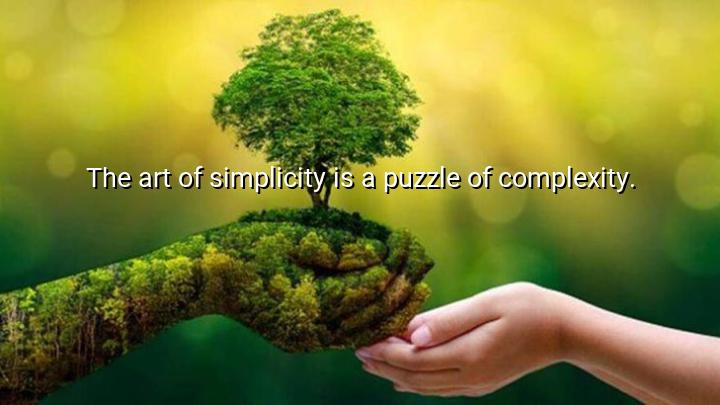




In this quote, Douglas Horton suggests that achieving simplicity in art—or in any endeavor—often requires navigating a complex and challenging process. The art of simplicity is not about being overly simplistic or trivial but about finding a way to express complex ideas, emotions, or concepts in a clear and straightforward manner. Horton highlights the paradox that simplicity is not achieved easily; instead, it often involves carefully distilling and refining complex elements to their most essential and meaningful form.
The origin of the quote can be understood in the context of Horton’s work as a clergyman and writer, who often reflected on the nature of spirituality and the human condition. His writing and teachings emphasized the importance of clarity and truth. This quote reflects his belief that, whether in communication, design, or life, simplicity requires a deep understanding of complexity. It’s not about stripping away meaning but about expressing that meaning in the most elegant and efficient way.
Horton’s statement also alludes to the broader concept that achieving simplicity in art or life involves a significant amount of effort and discipline. The complexity lies in knowing what to include and, perhaps more importantly, what to leave out. True simplicity is not about eliminating depth but about finding a way to present it without unnecessary distraction. This aligns with the idea that simplicity, in its highest form, can be powerful and meaningful precisely because it distills complexity into something that is universally understandable.
Ultimately, this quote speaks to the value of simplicity in art and life, but it also reminds us of the effort involved in achieving it. Horton’s perspective encourages us to embrace complexity as a necessary step in refining ideas, whether they are visual, intellectual, or emotional. Through thoughtful consideration and creativity, simplicity can emerge from complexity, offering clarity and beauty in its most pure and effective form.

HGNguyen Dinh Huong Giang
This quote hits home, especially in my work where we’re always trying to streamline user experiences. Every time we strip away extra elements, we realize how many decisions are hiding in that act. I wonder—how do you know when you’ve achieved the right level of simplicity? Is there a tipping point where removing more actually harms the core of what you’re trying to express or do?
MNQuang Minh Nong
I love the paradox here—it captures exactly why simplicity isn’t simple. It makes me question whether our modern obsession with minimalism is always genuine or if it sometimes ignores the layers beneath. Are we losing nuance in our pursuit of the 'clean and simple'? Or is the real skill knowing what to leave out while still preserving meaning? I’d like to hear different views on that.
TATuan Anh
This quote reminds me of how difficult it is to write a short, clear sentence that says everything it needs to. Why is it that distilling a big idea into something small and clear is so much harder than it looks? It makes me respect minimalism a lot more—especially in art, writing, and design. Have you ever had to simplify something that took you longer than building the complicated version?
TPTrang Phuong
I find this idea fascinating and frustrating at the same time. We always talk about the beauty of simplicity, but behind every 'simple' solution is often a web of complex thinking. It makes me wonder: is simplicity something we arrive at only after fully understanding the complexity? Or can it be a natural starting point? Is it possible to teach the skill of simplifying without oversimplifying?
TQPhan Thanh Quan
This quote really gets me thinking about how hard it is to make something truly simple—whether it’s a design, a speech, or even a life philosophy. Why is it that the simplest things often take the most work and thought to create? It feels like simplicity is often mistaken for laziness, but in reality, it’s usually the product of deep clarity and effort. What’s an example where you’ve seen that play out?