

The art of being happy lies in the power of extracting happiness from common things.
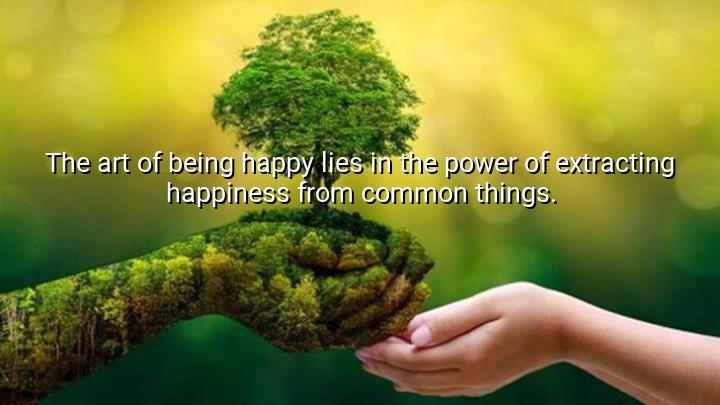




Henry Ward Beecher’s quote, “The art of being happy lies in the power of extracting happiness from common things,” reflects a timeless philosophy about finding joy in everyday life. Rather than relying on wealth, status, or extraordinary experiences, Beecher suggests that true happiness comes from appreciating the simple, often overlooked aspects of our daily existence. The “art” he refers to is not just a natural ability, but a cultivated skill—one that requires mindfulness, gratitude, and a shift in perspective.
Beecher, a prominent 19th-century American clergyman, abolitionist, and social reformer, was known for his progressive views and engaging sermons. He often spoke about the importance of spiritual well-being and moral character in achieving a fulfilling life. This quote aligns with his belief that inner peace and contentment are accessible to everyone, not just those with material success or comfort. By learning to cherish “common things”—a warm cup of tea, a walk in nature, or a kind word—we can unlock a more enduring form of happiness.
The phrase “power of extracting happiness” implies that joy doesn’t automatically arise from simple moments; it must be drawn out through intentional awareness and appreciation. This is what makes it an “art”—a conscious practice of seeing value and beauty where others might see only routine or insignificance. It speaks to the importance of cultivating a joyful mindset rather than constantly chasing bigger and better experiences.
Ultimately, Beecher’s quote is a gentle reminder that happiness is not found in what we lack, but in how we view what we already have. By turning our focus to the present moment and embracing life’s ordinary wonders, we gain the ability to find joy wherever we are. It’s a message of hope and humility, encouraging us to discover the extraordinary within the everyday.

OHOxi Hoang
I find this quote peaceful and grounding, especially in a time when we're encouraged to seek happiness in achievements, experiences, and external validation. But is there a danger in romanticizing simplicity too much? Could it ever lead to complacency or settling for less than we deserve? I’d love to explore how this mindset coexists with ambition and progress. Can we appreciate the present and still strive for more?
DBNguyen Duc Binh
This quote sounds simple, but I think it's actually pretty profound. It suggests that happiness isn't about changing our circumstances, but about changing our perspective. That’s empowering but also a little frustrating—what if someone is stuck in a really difficult situation? Is it fair to tell them to just look harder for joy in the ‘common’? How do we balance acceptance with ambition for something better?
BQnguyen bao quoc
Beecher’s idea feels very aligned with mindfulness, and I think it’s something we’ve lost touch with. When was the last time we really paid attention to how beautiful a sunset is, or how comforting a hot cup of tea can be? Maybe the problem isn't the lack of happiness around us but our lack of attention to it. Can technology and constant distraction be the biggest barriers to this kind of happiness?
TNLe Thi Thanh Nhan
Do you think the ability to find joy in simple things is a skill or a personality trait? Some people just seem naturally content, while others are constantly chasing something more. If it's a skill, how do we develop it—through gratitude, mindfulness, or maybe even boredom? I feel like this quote holds a quiet kind of wisdom that could be incredibly helpful in today’s overstimulated world.
DAVu Duy Anh
This quote makes me pause and reflect. It feels very wise, but also a little idealistic. Is everyone capable of finding happiness in ordinary moments, or is this a privilege that comes with a certain level of stability or security? For someone struggling to meet basic needs, does the idea of extracting happiness from the ‘common’ still apply, or does it oversimplify deeper challenges people face?