

The aim of art is to represent not the outward appearance of things, but their inward significance.
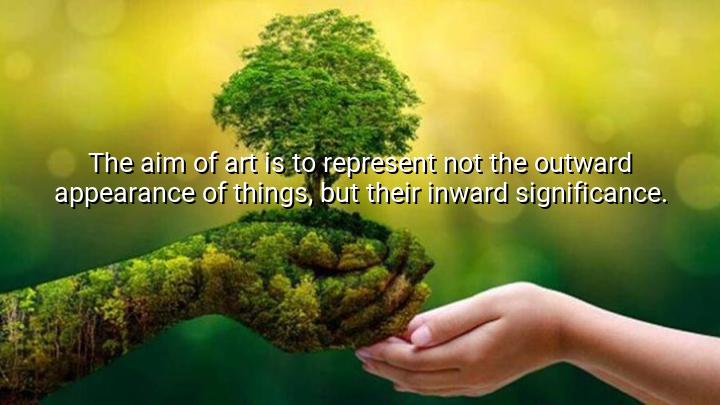




The quote "The aim of art is to represent not the outward appearance of things, but their inward significance" by Aristotle emphasizes that the true purpose of art is not merely to depict the physical world, but to reveal deeper truths about the human experience and the essence of reality. According to Aristotle, art should go beyond surface-level representation, focusing instead on the inner meaning and significance of the subject. This perspective encourages artists to explore and express the emotional, spiritual, and philosophical aspects of life, rather than simply capturing its external features.
Aristotle's view aligns with the concept of art as a tool for understanding and interpreting the world. While realism and technical accuracy in depicting physical appearances are valuable, Aristotle believed that art's greater role is to uncover the deeper, often hidden meanings that govern human nature and the universe. By focusing on the inward significance of things, art allows viewers to connect with the underlying emotions, ideas, and truths that shape the world around them.
This idea also connects to Aristotle’s broader philosophy, particularly his emphasis on the pursuit of higher knowledge and the exploration of universal truths. In his view, art is a way to access and communicate profound insights about existence. Rather than simply representing what is seen, art gives expression to the unseen, the emotional, and the intellectual, offering a deeper understanding of life itself.
Ultimately, Aristotle’s quote underscores the belief that the true value of art lies in its ability to reveal deeper layers of meaning and to provoke thought, rather than merely imitating the physical world. Through the lens of art, the artist can communicate profound truths about existence, emotions, and the human condition, encouraging viewers to reflect on the deeper significance of the world around them.

THLe Vo Thanh Huyen
I like the idea that art goes beyond surface-level observation, but does it always have to be about deeper meaning? What happens when an artwork is just meant to evoke beauty or pleasure without a philosophical or emotional weight behind it? Can something that’s visually pleasing, like a landscape or portrait, still carry significant emotional depth? Do we undervalue works that focus purely on aesthetics?
TYTran Yen
The idea that art represents the 'inward significance' rather than just appearances raises some questions. If an artist’s goal is to reveal the deeper meaning behind things, how can viewers be sure they’re seeing it? How do we differentiate between an artist’s intention and the viewer’s personal interpretation? Is it possible for art to communicate its true essence, or do we always bring our own biases and experiences to the table?
DMDuc Mai
I find this quote intriguing because it suggests that art isn’t just about what’s visible, but about what lies beneath. But how do we interpret works that focus solely on the physical world—like hyperrealism, for example? Do they also convey inward significance, or is their value based purely on their external appearance? Can art exist purely for its aesthetic appeal, or must it always delve into deeper meanings?
NTTrinh Kieu Ngo Thi
This quote seems to suggest that art’s deeper purpose lies beyond mere replication of the world we see around us. But is it possible for an artwork to simultaneously capture both the outward and inward aspects? Can we really ignore the visual form when interpreting an artwork, or does the way things look also hold significant meaning? Does art have to transcend the visible to express its true significance?
MTMinh Thu
Aristotle’s view on art is compelling. If art is about capturing the inner essence of things rather than their outward appearance, does that mean the focus of art should always be on emotions and ideas instead of physical reality? How does this apply to abstract art, where form often takes precedence over deeper meanings? Is there a clear distinction between art that represents the 'outward' versus the 'inward'?