

That's why people listen to music or look at paintings. To get in touch with that wholeness.
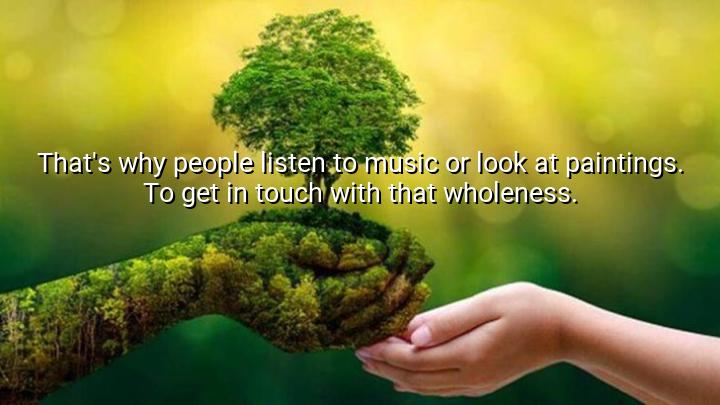




The quote "That's why people listen to music or look at paintings. To get in touch with that wholeness" by Corita Kent speaks to the power of art to connect individuals with something larger than themselves. Kent, a renowned artist and activist, believed that music and paintings have the ability to convey emotions and ideas that transcend the everyday experience. By engaging with these forms of art, people can access a sense of wholeness, or a feeling of completeness and unity, that might be hard to find in the complexity of daily life.
Kent’s perspective emphasizes the transformative power of art. Whether through the rhythmic patterns of music or the visual language of painting, art serves as a bridge to deeper emotional or spiritual states. The act of listening or viewing becomes a way for people to step outside themselves and experience a sense of collective harmony or peace. This sense of wholeness may be seen as a moment of clarity, calm, or even connection to something beyond the individual, such as a community, nature, or the human experience as a whole.
This idea also reflects Kent's own approach to art. As a printmaker and teacher, she was deeply influenced by social justice and the desire to create art that could uplift and inspire people. For Kent, art was not just about aesthetic beauty or technical skill, but about fostering connections and evoking a sense of collective consciousness and shared human experience. Music and visual art were ways to communicate universal feelings that resonate with all people, helping them to feel more whole and in tune with themselves.
Ultimately, Kent’s quote highlights the idea that art is a tool for personal and collective healing and understanding. Through art, people can engage with a deeper, more unified sense of reality, offering an escape from the fragmented, chaotic nature of everyday life and inviting a return to a state of balance and harmony. Art allows individuals to reconnect with their inner selves and the world around them, facilitating a sense of wholeness that might otherwise remain elusive.

LNHai Dang Le Nguyen
I really connect with this thought. There’s a calm and clarity that comes over me when I sit with a painting or hear the right song—it feels like all the noisy parts of life get quiet. But is that what wholeness is? Or is it more about remembering who we are at our core? I’d love to hear how others define this feeling and what kinds of art bring them closest to it.
HTHuynh Thi
This quote made me stop and think—what does it mean to feel whole, and how exactly does art help us reach that state? Does it mirror our emotions, give us perspective, or allow us to feel something deeply that’s otherwise inaccessible? Sometimes I wonder if the connection to wholeness is less about the art itself and more about the pause it creates—a moment when we’re allowed to just be fully human.
H911. Vy Thi Mong Hoai 9a7
Is Corita Kent suggesting that we’re not whole without art? That’s a powerful idea. It implies art isn’t a luxury or entertainment, but something essential to our being. I’m intrigued by the psychological or even existential implication of this. Could it be that engaging with art is a way of healing something broken or fragmented within us? And if so, is there a danger in losing access to the arts in modern society?
NTMai Vo Ngoc Tram
I love this quote—it explains why I return to the same songs or artworks during difficult times. They give me a sense of grounding, like they restore something scattered within me. But I’m curious: can we achieve that same feeling of wholeness through creating art, not just consuming it? Is the act of creation just as healing and integrative as the experience of witnessing beauty?
TVTan Vu
This quote really resonates with me. There’s something about the idea of 'wholeness' that feels so deeply needed, especially in today’s fragmented, fast-paced world. But what does 'wholeness' really mean? Is it emotional balance, spiritual connection, or simply feeling present? I wonder if the type of art we’re drawn to reveals the part of ourselves we’re trying to reconnect with. What do others think we’re really searching for in art and music?