

Technology, like art, is a soaring exercise of the human imagination.
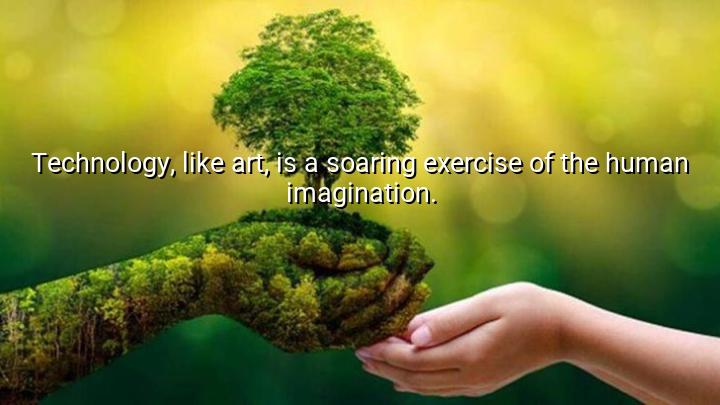




The quote by Daniel Bell highlights the close relationship between technology and art, emphasizing that both are creative processes rooted in the human imagination. Bell suggests that, just like art, technology is a way for humans to explore and express their creativity, pushing the boundaries of what is possible. The idea of soaring exercise indicates the freedom and boundless potential that both fields offer, allowing for innovation and the development of new ideas.
Bell's comparison between technology and art also points to the notion that both are transformative forces in society. Art has the power to change perspectives, provoke thought, and inspire change, much like how technology reshapes our lives and societies. The emphasis on imagination shows that, while technology often involves practical applications, it is driven by creative thinking and the desire to solve problems in new ways.
The origin of this quote is rooted in Bell's broader views on the role of technology in modern society, where he often discussed the ways in which technological advancements were shaped by human imagination and vision. As a sociologist, Bell recognized the profound impact of both art and technology on culture, believing that they were integral to the advancement of civilization. His work reflects the idea that innovation in any form is a product of human thought, not just a mere scientific or technical achievement.

LLEANHKHOA
I agree that both art and technology stem from human creativity, but I wonder: is one more personal than the other? Art often feels like it comes from emotion, from an inner place, while tech feels external—problem-solving, tool-making. Can technology ever be as intimate and expressive as a painting or poem, or is it inherently more collective and utilitarian?
VKNguyen Dai Vinh khang
Honestly, I never thought of technology as a product of imagination in the same way art is. It makes me curious—can the people designing apps or building robots be considered artists too? Does the emotional impact or aesthetic beauty of tech play a role in whether it's considered artistic, or is it the process of invention that counts most?
VVTrieu Viet Vuong
I love the optimism in this quote. But with today’s AI, biotech, and digital tools, I wonder—can technology still be considered an act of imagination when algorithms now generate content? Is the human still at the center of technological creativity, or are we outsourcing that imaginative spark to the machines we've built?
HPDo Nguyen Hoang Phuc
I find this comparison fascinating because it elevates both disciplines. But do you think all technological innovation is rooted in imagination, or is some of it purely functional? Where do we draw the line between practical engineering and imaginative creation? Could this be why some tech, like smartphones or VR, feels more 'alive' or even beautiful than others?
TMDuyen Nguyen Thi My
This quote makes me reflect on how often we separate technology and art, when they’re really both driven by imagination and vision. I wonder—if we viewed engineers and artists through the same lens, how would that change education or innovation? Are tech creators being recognized as artists in their own right, or are we still trapped in rigid categories that limit both fields?