

Solitude is independence.
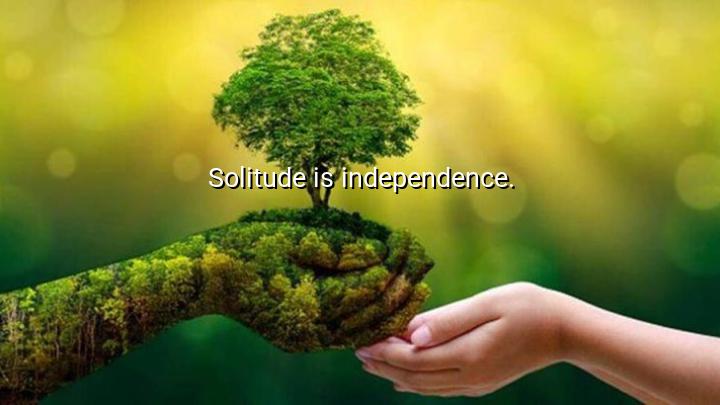




The quote "Solitude is independence" by Hermann Hesse expresses the idea that being alone is not a weakness or a state to fear, but a form of personal freedom. In solitude, one is free from external influences, social expectations, and the noise of the world. Hesse views it as a space where true self-reliance and inner strength can develop—where a person learns to think, feel, and live authentically.
Hermann Hesse, a German-born novelist, poet, and philosopher, often explored themes of individualism, spiritual growth, and the inner journey. This quote is drawn from his novel Steppenwolf, a deeply introspective work that examines the conflict between the individual and society. In this context, the quote emphasizes that true independence is achieved not through rebellion, but through embracing one’s solitary nature and learning to find meaning from within.
By equating solitude with independence, Hesse challenges the common view that being alone is undesirable or lonely. Instead, he elevates it as a powerful state of self-possession, where one is free to explore thought, emotion, and creativity without compromise. This form of independence is not about separation from others out of resentment, but about cultivating a strong, centered sense of selfhood.
Ultimately, Hesse’s quote invites us to reconsider the value of being alone. In a world that often pressures us to stay connected and conform, solitude becomes an act of courage—a path to discovering who we truly are when no one else is watching. It’s a reminder that real freedom often begins within.

CPChinh Pham
This quote reminds me of monastic traditions where solitude is seen as a form of spiritual liberation. But I wonder, in our hyperconnected world, is solitude even possible without effort? And when we do find it, do we actually feel free—or do we feel left out, anxious, or disconnected? I’m curious how people interpret this idea today, especially younger generations raised in a digital culture where independence is often tied to visibility.
CVCat Van
There’s a quiet power in this statement. But I find myself torn—can solitude offer independence without leading to emotional detachment or a lack of empathy? I’ve known people who cherish being alone but struggle when re-entering social dynamics. Does too much solitude erode our ability to collaborate, compromise, or connect? I’d love to understand how one balances personal freedom with the responsibilities of community and human closeness.
TLNguyen Thi Thuy Linh
I feel like this quote speaks directly to introverts, but I also wonder: is solitude the *only* path to independence? Can’t we develop independence in the midst of connection, by setting boundaries and honoring our individuality within relationships? I appreciate the romanticism here, but I think there’s room for nuance. Solitude may be one route, but is it always the most sustainable or healthy one in the long term?
HMLe Hai Minh
This quote resonates deeply with me, especially as someone who finds clarity when I’m alone. Still, I question whether solitude is always empowering. What about when it becomes a defense mechanism or a response to rejection or fear? In those cases, is it still independence—or something more fragile and reactionary? I’d love to hear perspectives on when solitude becomes a gift versus when it starts to feel like exile.
GBnguyen van gia binh
I really like the simplicity of this quote—it packs so much into four words. But I’m curious, does independence gained through solitude mean we’re cutting ourselves off from the benefits of interdependence? Can you truly be independent while still maintaining close, meaningful relationships? It seems like a fine balance. I'm wondering if Hesse is promoting isolation as a path to freedom or simply highlighting the strength found in self-reliance.