

Our mind is capable of passing beyond the dividing line we have drawn for it. Beyond the pairs of opposites of which the world consists, other, new insights begin.
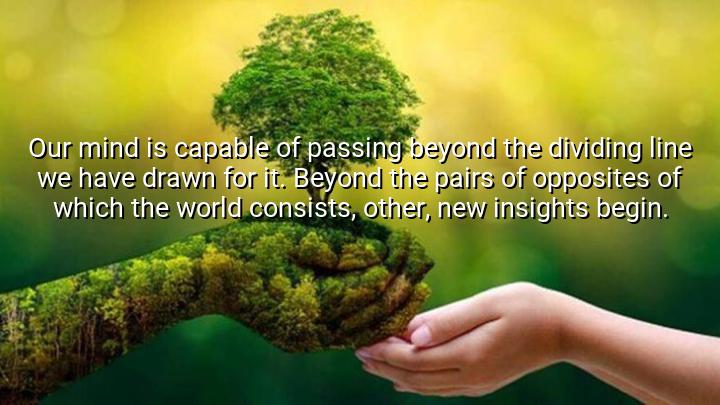




The quote "Our mind is capable of passing beyond the dividing line we have drawn for it. Beyond the pairs of opposites of which the world consists, other, new insights begin" by Hermann Hesse suggests that human consciousness has the potential to transcend the limitations imposed by conventional thought. Hesse, a German-Swiss author known for his philosophical and spiritual works, argues that our mind often operates within a framework of dichotomies—good vs. evil, right vs. wrong, light vs. dark—but true understanding emerges when we move beyond these opposing forces and explore a deeper, more holistic perspective.
Hesse’s quote reflects his belief in the potential for personal transformation. The "dividing line" represents the boundaries we set based on our limited perspectives, often defined by societal norms or rigid belief systems. He suggests that by breaking free from these boundaries, we can access new insights that offer a broader, more integrated view of the world. This aligns with Hesse's focus on spirituality, self-awareness, and the quest for inner peace through the reconciliation of opposites.
The origin of this quote comes from Hesse’s exploration of individualism and spiritual growth in works like Siddhartha and Steppenwolf. His writing often dealt with themes of inner conflict, the search for truth, and the journey to transcend conventional societal boundaries. In his own life, Hesse struggled with personal disillusionment and sought deeper meaning through Eastern philosophy and psychology, which encouraged a more fluid, integrated understanding of the self and the world.
Ultimately, Hesse’s quote encourages us to move beyond duality and rigid thinking. It suggests that the true nature of reality is not confined to the black-and-white distinctions we often make, but lies in a realm of complexity and interconnection that requires openness and deeper reflection. By breaking free from these mental divisions, we open ourselves up to new perspectives and insights that can lead to profound personal and spiritual growth.

AAdministratorAdministrator
Welcome, honored guests. Please leave a comment, we will respond soon