

The call of death is a call of love. Death can be sweet if we answer it in the affirmative, if we accept it as one of the great eternal forms of life and transformation.
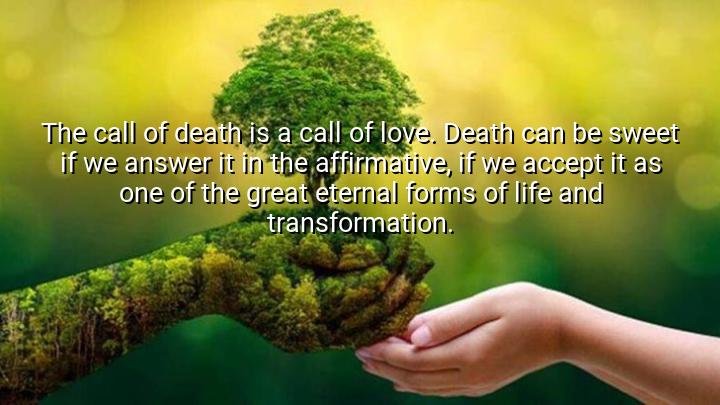




The quote "The call of death is a call of love. Death can be sweet if we answer it in the affirmative, if we accept it as one of the great eternal forms of life and transformation" by Hermann Hesse reflects his philosophical and spiritual perspective on death as an integral part of the cycle of existence. Hesse, a German-Swiss author known for works like Steppenwolf and Siddhartha, often explored themes of spirituality, self-realization, and the connection between life and death. In this quote, he suggests that death is not something to fear but a natural transition—one that is intertwined with love and transformation.
Hesse views death as an inevitable and transformative part of the human experience. By referring to it as a "call of love," he conveys the idea that death should be embraced rather than feared, as it brings the opportunity for personal and spiritual renewal. This idea aligns with Hesse’s belief in the cyclical nature of life and death, where death is not an end but a transformation that allows for a deeper understanding of existence.
The notion of death as a form of transformation is central to Hesse’s philosophy. In his writing, he often depicts characters undergoing profound changes, both in life and in death, as part of their spiritual journey. For Hesse, answering the call of death in the affirmative is a way of accepting it as part of the eternal flow of life, which offers a kind of peace and fulfillment. This acceptance of death as an integral and loving force opens the way for a deeper connection to the mysteries of existence.
Ultimately, Hesse’s quote offers a comforting and spiritual perspective on death. Rather than viewing it as something final or fearful, he invites us to see it as a sweet release, a part of the great cycle of life and transformation. By embracing death with acceptance and love, Hesse believes that we can find peace and even transcendence in the face of the inevitable.

AAdministratorAdministrator
Welcome, honored guests. Please leave a comment, we will respond soon